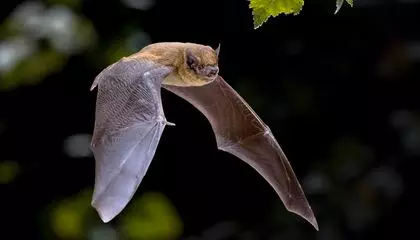
But they do rely heavily on sound—rather than vision—to confidently swoop through the night. They use echolocation to map out their immediate environment, sending out signals and waiting for the sound waves to boomerang back after bouncing off background objects and prey. It’s remarkably effective.
The world is a cluttered place, though, and bats don’t want a constant deluge of signals. What they want—and don’t we all—is to chatter with friends and enjoy a tasty meal. So how do they pick out the interesting echoes from the pile of sonic slop?
And how can they hear and be heard over the din? Most bats’ echolocation calls are too high-pitched for humans to hear, putting them in the range of ultrasound. But bats make other sounds to communicate, including purrs, clicks and buzzes that may precede mating.
Researchers are still teasing out exactly how different species of bats use noise to navigate their complex environments. But it’s clear that the creatures are succeeding, thanks to keen manipulations of the rules of physics and a wider web of senses than you may think. Here are four fascinating ways that recent science has added to our understanding of bats’ sensory soundscapes, revealing how the flying mammals work to make sense of it all.
Many people think of echolocation as a straightforward call and response, says Holderied. A bat sends out one signal, an insect reflects back a tantalizing echo, and dinner is served. Reality is rather more complicated.
The forest is chock-full of things that echo, with trees, rocks and other obstacles constantly sending back conflicting signals. For years, Holderied has been trying to understand how bats make meaning out of their environment’s muddle of echoes. Complicating bat perception even further is the Doppler effect.
Extract — continue reading at the source.