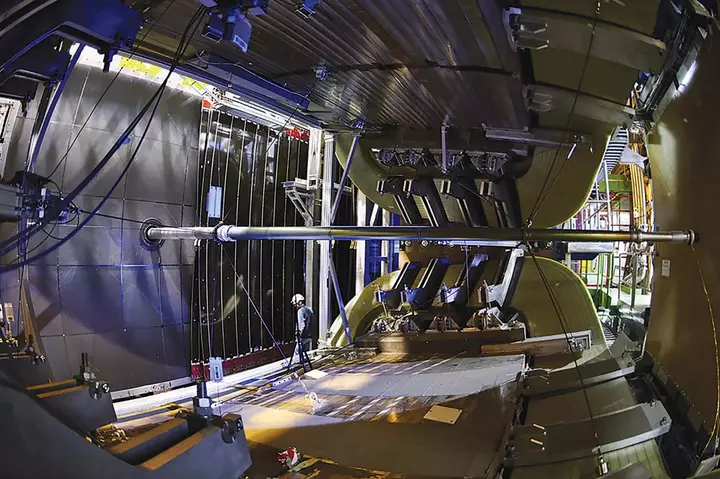
Welcome to the zeptoverse, the world of the unprecedentedly small. A new analysis of data from the Large Hadron Collider has uncovered an extraordinarily rare particle decay that opens the door to this realm and its secrets. The standard model of particle physics tabulates all known particles and how they interact, but it cannot explain dark matter and dark energy, which fill most of our universe.
Consequently, researchers test its predictions in particle collider experiments, searching for signs of new particles and forces. Now, Paula Collins and her colleagues at the Large Hadron Collider beauty (LHCb) experiment at CERN in Switzerland have found the first evidence of a rare decay involving the “beauty quark” particle, which opens a whole new world for these searches. This process is exceedingly rare and has eluded experiments for decades.
This means the chance that the signal in the experiment occurred randomly instead of being meaningful is about 0.3 per cent. Cliff says future experiments ought to lower this uncertainty, but the data already reveals that we have reached the zeptoverse, a world at scales as small as sextillionths of a metre – the smallest ever explored. Yet undiscovered denizens of this world could influence the beauty particle decay process and because the process is so rare, researchers would immediately spot that change, says Collins.
In this way, measuring this process is like surveying the zeptoverse. He says this was made possible by technical upgrades that the LHCb team has made in recent years. This process is not only ultra-rare but mathematical theories predict it very well so investigating it makes for a particularly important test of the standard model, says Cristina Lazzeroni at the University of Birmingham in the UK.
The new measurement is consistent with the standard model, but Ligeti says this does not mean that all possible new particles have been ruled out. In his view, the new measurement implies that effects of such particles must be small but not necessarily negligible and LHCb could quantify this further going forward. Cliff, however, is worried about the future of the team’s research because last year the UK government withdrew funding from a planned LHCb upgrade.
Extract — continue reading at the source.


