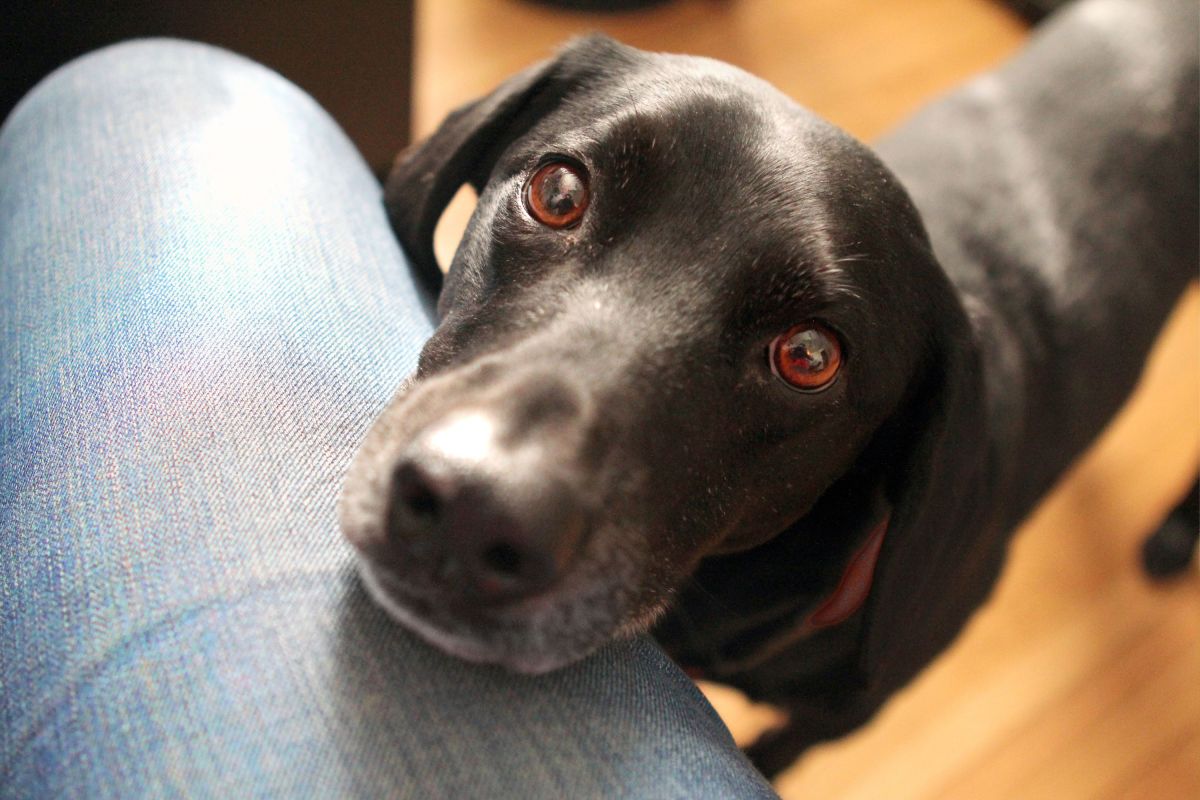
You may think you're doing a pretty good job of hiding a bad mood from your pet, but even if you remain calm and carry on with your normal routine, your animal companion may be reacting to those subtle changes. Dogs, in particular, are constantly taking in information from the people around them. They can pick up on changes in facial expressions, body language, movement, breathing, voice and even scent, Shawna Baskette, a dog behavior researcher and founder of The Dog Library, told Newsweek.
"If we think we're successfully hiding stress by keeping our voice calm, we're wrong," Baskette said. "Our physiology gives us away." And when dogs pick up on those changes, it can sometimes show up in their behavior. A dog may become more clingy, restless or withdrawn, for example, or even become more fearful or difficult to handle.
Veterinary surgeon Mathieu Glassman has seen this play out in his own exam rooms. Glassman told Newsweek that when an owner is particularly stressed or anxious during a veterinary visit, their dog can sometimes become fearful, aggressive or difficult to handle. But when he takes the dog into the examination area away from the owner, the animal may become noticeably calmer and behave like a "completely different animal." Glassman believes dogs often respond to their owner's anxiety or pick up on their other emotions, although he noted that an animal may also be trying to protect its owner.
Research has shown that dogs can detect changes in our bodies that accompany stress. In a 2022 PLOS ONE study, dogs correctly distinguished between both breath and sweat samples from 36 people before and after they completed a psychological stress task with 93.75 percent accuracy. The findings suggested dogs can detect stress-produced changes in compounds released through human breath and sweat.
And the connection may not stop at detection. Other research has also found correlations between dogs' and owners' long-term cortisol levels, as well as aspects of their heart-rate variability and activity during interactions. Together, these findings suggest that the relationship between people and their dogs can involve a degree of physiological and behavioral co-regulation, Baskette said.
That doesn't necessarily mean dogs consciously absorb or understand their owners' emotions. Instead, they may be highly responsive to the physical and behavioral signals that accompany those emotions. "Our dogs are incredibly attentive to our moods and emotions, even when we're not deliberately communicating anything," Baskette said.
Extract — continue reading at the source.