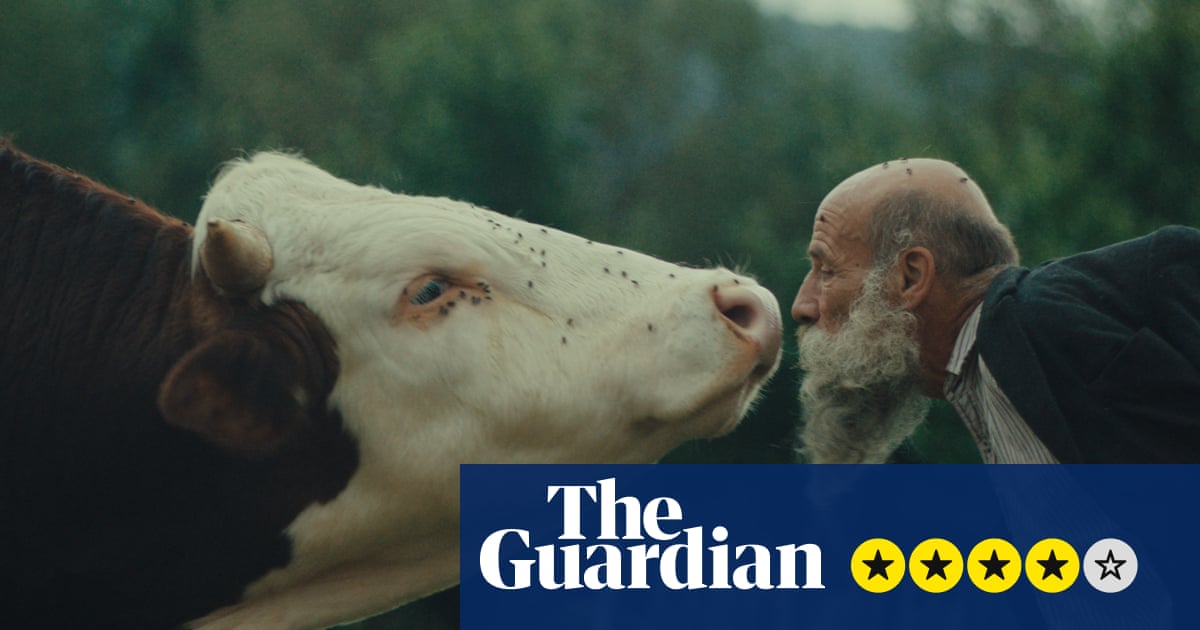
Narrated by a slaughtered bull, this extraordinary film takes the less-travelled path in charting the daily life of a pair of Czech twins a long way off conventional routes themselves. František and Ondřej Klišík are slowly going mad – or maybe closing in on enlightenment – in a cabin in the Šumava mountains and, extrapolating a short story about the brothers by Aleš Palán, director Miro Remo succumbs productively to the prevailing cabin fever – not only egging these longbeards on in their squabbling and loopy philosophising, but pitching in with his own fabulism and surrealism. Closing on 60, “Franta” and “Ondra” still farm their smallholding with the help of Nandy, a mutinous bull ill-chosen as a draught animal.
In their downtime, they booze, banter and bicker, lament their lack of prospects with the fairer sex, and blow off steam in epic arm-wrestling bouts. Despite an arm lost to a sawmill accident, it’s Franta who’s usually the victor; he is also possessed by a quixotic streak absent in his bluff sibling. Letting loose streams of poetry into the air like bunting, wishing “joy to all conscious beings”, he is also constructing his own Da Vinci-style perpetual flying machine.
The Klišíks are definitely not “boring cunts”, as they dub 99% of humanity (including Vladimir Putin). They were decorated by the Czech state for their anti-Soviet activism, but that engagement seems to have waned, and Remo follows them away from the political deep into the personal and spiritual. In an intense communion with nature, including the animals they kill, they seem to inhabit a strange prelapsarian haven, inside which discord is continually bubbling up.
Franta slates Ondra for his alcoholism, into which he is drawn; they differ on which one of them is Cain and which is Abel. In the end, they settle: they’re both Abel. As these spats recur and resolve themselves in kitchen-table laughter, it’s like watching some natural dialectical process in motion; a dishevelled but beautiful ying-yang cohabitation.
The twins are ready collaborators in their own mythologisation, participating in Remo’s more leftfield plays, such as sequences where Ondra sledgehammers through the spiral mural on the wall between their rooms, or a dream featuring a levitating Franta. But shortly after the film won the Grand Prix at Karlovy Vary film festival last year, Franta died in a village pond. This took self-mythologisation too far, but his mystical remit still stands though; there is copious wisdom regarding family, nature, interdependency and love in this rowdy, rapturous and brilliant film.
Extract — continue reading at the source.