For most of his 39 years, Josias Dias dos Santos, known as Jota, has endured degrading cycles of displacement as a quilombola, a descendant of Black people once enslaved on Brazil’s sugar cane and coffee plantations. He says his and other quilombola families subsisting in the rainforests in Pará, northern Brazil, were first forced out of their settlements by violent loggers, then by ranchers and miners. Yet, they say the worst came with the arrival of the palm oil industry in what is now the country’s most deforested state.
Palm oil companies producing biofuels and supplying global customers, subsidised by the federal government, have laid claim to ever larger tracts of traditional quilombola territory over the past two decades. Since then, Dias dos Santos says, the companies have put up mazes of fencing, guard towers and security checkpoints, sometimes cutting communities off from their family cemeteries. Leaders who attempted to speak out for their land rights and against toxic industrial waste were often either jailed or gunned down in ambushes that went unprosecuted.
Now quilombolas fear the second round of Brazil’s presidential elections will heighten the threat to the forest and its people. Many say a victory for Flavio Bolsonaro, the son of the imprisoned former president Jair Bolsonaro, would make securing the formal recognition of their land rights “impossible”. Dias dos Santos was barely seven years old when loggers forced his and other quilombola families to flee their homes near an abandoned sugar mill, where their enslaved ancestors once worked.
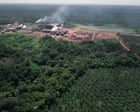
After the loggers came the palm oil industry. With government encouragement, the industry set out to acquire large tracts of land in northern Pará. Today, about 202,000 hectares (500,000 acres), much of it near the Acará River, are used to produce palm oil for biofuels and a wide range of foods.
For years, quilombola communities complained that the companies were squeezing them off their traditional lands. They also claimed their families were being affected by a toxic chemical byproduct of palm oil production, which also plagued the Acará River with bloated, dead fish. Quilombola activists who led protests and failed attempts to reclaim land met violent ends.
One leader, Artemio Gusmão, was decapitated and dismembered; another was shot 16 times in the back. Tensions between the quilombolas and the palm oil companies increased in 2020 after Brasil BioFuels (BBF) took over a large operation in the region. It built a complex of fences, gates and watchtowers guarded by private security guards and began systematically filing more than 1,000 police reports accusing quilombolas of making threats, damaging property and stealing its equipment.
Extract — continue reading at the source.