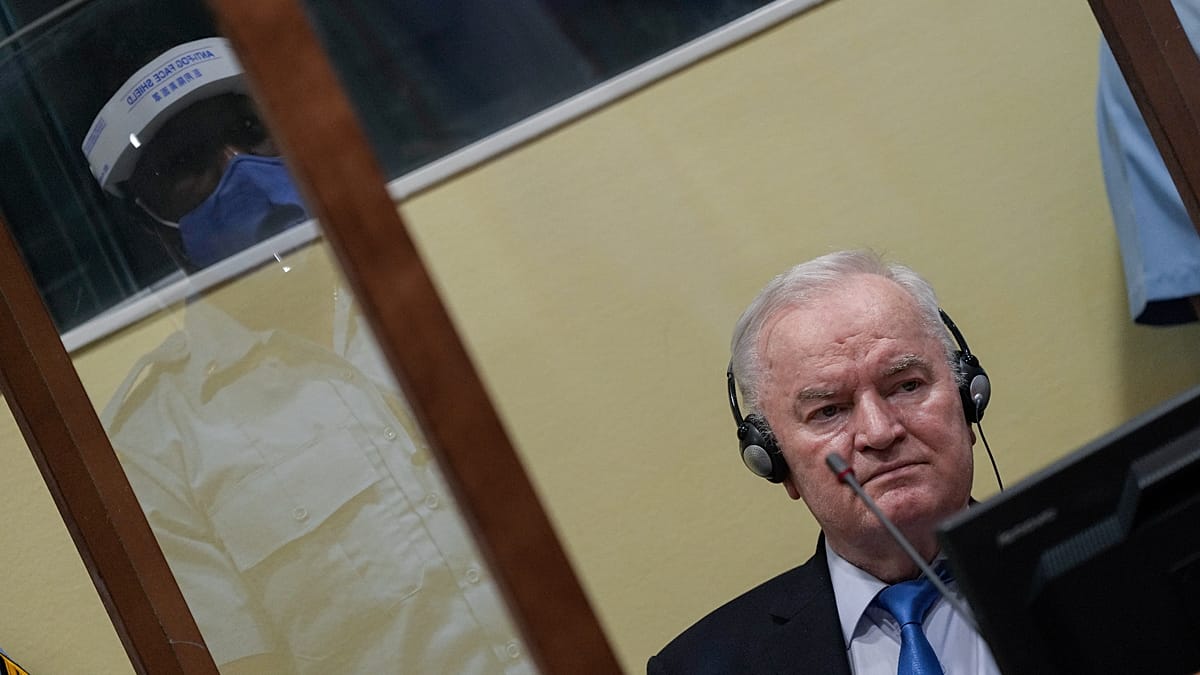
A commemoration for former Bosnian Serb army commander and convicted war criminal Ratko Mladić opened on Saturday at the House of the Serbian Army in Belgrade as Serbia faces mounting European pressure over what Brussels has described as his glorification — an accusation Serbia rejects. Mladić died last week while serving a life sentence for genocide, war crimes and crimes against humanity during the 1992-1995 war in Bosnia. His remains were flown to Serbia from The Hague on a government plane on Thursday.
Serbian army soldiers carried the coffin with Mladić’s body wrapped in the national flag from the plane to an unmarked maroon van, which was then given a police escort down Belgrade’s main motorway. Serbia's Justice Minister Nenad Vujić — who initially announced that Serbia would give Mladić "all the military and state honours" — was on the plane along with Mladić’s son Darko and two of his former army assistants. The body was transferred to the military hospital in Belgrade for an autopsy before his coffin is displayed at a church near the Košutnjak cemetery on Monday morning, where he will be buried later in the day, his family announced on Friday.
He will be buried without state or military honours, with no serving officials in attendance including President Aleksandar Vučić, the prime minister and the speaker of parliament, Euronews has learned. There will be no artillery salutes or ceremonial military presence, and he will not be buried in the Alley of the Greats or the Alley of Distinguished Citizens despite requests to that effect. Serbian authorities clarified earlier that Saturday's commemoration — also not attended by Belgrade officials — was not organised by the state, but rather by an association of retired generals.
Mladić's family said he would be buried next to his daughter, who died by suicide in the 1990s, according to domestic media outlets. Belgrade has contributed to covering Mladić's personal expenses and family visits while at the Hague tribunal, and has repeatedly asked for an early release on humanitarian grounds due to his declining health in recent years. After Bosnia declared independence from Yugoslavia in early 1992 following in the footsteps of Slovenia and Croatia, Bosnian Serb leaders, backed by the government in Belgrade led by Slobodan Milošević, created their own parastate.
The ensuing military offensive led by Mladić — a career Yugoslav army officer who also took part in the fighting in neighbouring Croatia — aimed at ethnically cleansing as much of the country’s territory as possible of the other two ethnic groups, Bosniaks and Croats. The International Criminal Tribunal for the former Yugoslavia (ICTY) convicted Mladić of genocide for orchestrating summary executions of more than 8,000 Bosniak men and boys in Srebrenica in July 1995 — considered the worst bloodbath on European soil since the end of World War II. He was also found guilty of war crimes and crimes against humanity during the siege of Sarajevo, the longest siege of a capital city in modern warfare.
His troops in the surrounding hills terrorised the residents of the Bosnian capital with daily shelling and sniping for nearly four years after the war broke out in early 1992. Known as the “Butcher of Bosnia,” he became the most notorious figure of the war in the former Yugoslav republic of 3,5 million that left more than 100,000 people dead and over 2 million displaced or seeking refuge abroad before it ended in 1995 in a US-brokered peace agreement. Serbian President Aleksandar Vučić predicted that Mladić’s admirers — who consider him a hero despite his sentence — could come to the funeral in large numbers.
Extract — continue reading at the source.