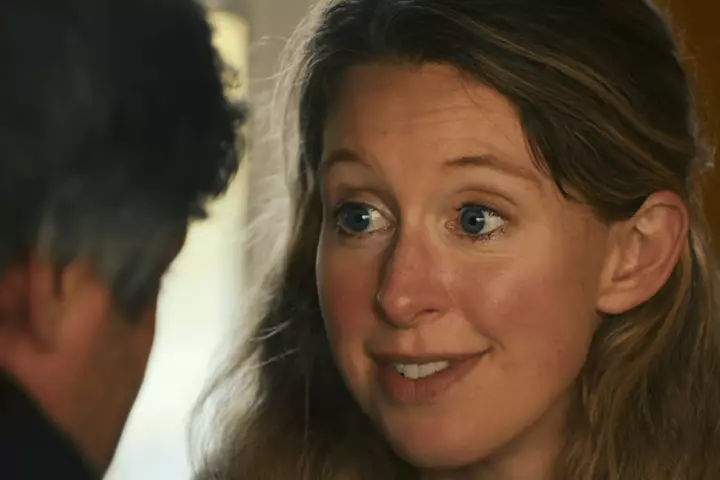
Director Nathan Fielder and Lance Oppenheim’s much-hyped look at Elizabeth Holmes has generated a massive $15 million from just 855 theaters. Those ticket sales were enough for second place behind another newcomer, Paramount’s video game adaptation “Street Fighter,” which opened to $30 million from 3,575 venues. Heading into the weekend, “You Can See Everything” was aiming for $7 million to $8 million, which would have been remarkable for a documentary, especially one that doesn’t involve music or capture a wildly popular concert.
Not to mention, this one runs at nearly three hours and wasn’t on anyone’s radar until two months ago. After a surprise world premiere at Telluride Film Festival, “You Can See Everything” became a word-of-mouth sensation, bolstered by some of the best reviews of the year. A24, which produced the movie in secret over three years for roughly $7 million, reported more than 2,000 sold-out screenings as audiences rushed to theaters to avoid spoilers on the stranger-than-fiction story about the Theranos founder before she began an 11-year prison sentence for defrauding investors.
Around 70% of opening weekend crowds were under 35 years old, and, according to exit polls, 90% of ticket buyers would “definitely recommend” the film and 80% said it was “even better than expected.” Those reactions signal a long theatrical life for the movie, which is expanding nationwide in the weeks to come. Gross, who publishes the box office newsletter FranchiseRe. That film opened to $7.1 million from 1,778 theaters — at the time registering as the biggest opening for a non-music or concert doc in over a decade — and ended its run with $16.3 million. (“You Can See Everything” carries a budget in the single digits and will be much more profitable than “Melania.) Among its opening weekend bona fides, “You Can See Everything” secured the largest debut for any film playing on under 1,000 screens since 2006’s “Borat,” which ignited to $26 million from 837 theaters (not adjusted for inflation).
And it’s the biggest opening for a documentary in over 20 years, since 2004’s seminal “Fahrenheit 9/11,” which premiered to $24 million from 868 theaters (not adjusted for inflation). Ticket sales for “You Can See Everything” are notable, not just for a documentary, but any arthouse release these days. By comparison, A24’s box office hit “The Drama,” anchored by two of Hollywood’s biggest stars in Zendaya and Robert Pattinson, opened earlier this year to $14.3 million from 3,087 theaters.
Critics and audiences were lukewarm on the video game reboot, which landed a “B-” grade on CinemaScore exit polls and a 42% on Rotten Tomatoes. Directed by Kitao Sakurai and starring Noah Centineo and Andrew Koji, “Street Fighter” follows two estranged fighters who are recruited to enter a tournament that forces them to face off against each other. Legendary and video game developer Capcom co-financed “Street Fighter” for $82 million, with Paramount only on the hook for distribution.
The long-gestating film was originally set at Sony as part of Legendary’s pact with the studio and moved to Paramount once the initial deal expired. It’s the third movie based on the Capcom video game series following 1994’s box office winner “Street Fighter,” starring Jean-Claude Van Damme, and 2009’s misfire “Street Fighter: The Legend of Chun-Li.” “Whalefall” and “Sense and Sensibility,” two other newcomers, launched in fourth and fifth place, respectively. Disney and 20th Century’s “Whalefall,” a survival thriller starring Austin Abrams as a scuba diver who is swallowed by a sperm whale, missed expectations with $8 million from 3,065 locations.
Extract — continue reading at the source.