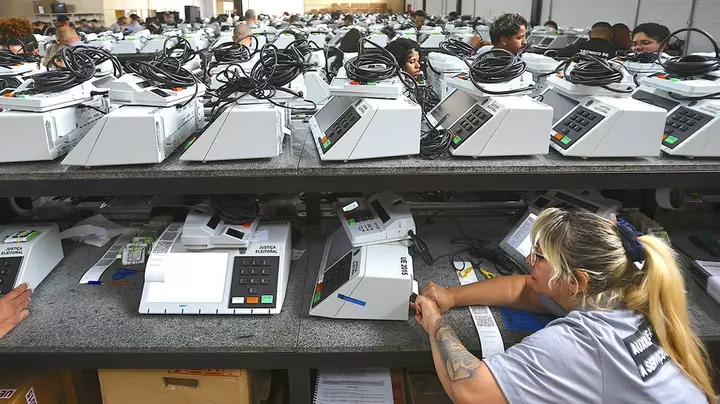
SAO PAULO, Brazil— About 125 million Brazilians voted Oct. 4 on machines that print no paper ballots. Less than four hours after polls closed, the country knew its presidential election was headed to a runoff between conservative challenger Flavio Bolsonaro and leftist President Luiz Inacio Lula da Silva. That process has been in place for over three decades, and Brazilians have become accustomed to its speed, simplicity, accuracy and routine.
The system is robustly audited, completely disconnected from the Internet, and is the largest digital voting system deployed on the planet. Eleven days before the U.S. midterms, Brazil’s system, analysts say, could offer Americans a more secure way to vote. The system has been widely praised and was also mentioned in President Donald Trump’s 2025 executive order on elections, where he cited Brazil’s biometric voter identification as an example.
Yet Brazil’s count runs partially on the kind of paperless machines that the president has vowed to scrap. STATE DEPARTMENT CONSIDERS SHARING PASSPORT RECORDS FOR VOTER CITIZENSHIP CHECKS Over the years, Brazil merged federal, state and municipal databases into a digital voting record, whereby voter identity, eligibility and single ability to vote can (and usually must) be verified biometrically. Nearly 9 in 10 voters unlock the machines with a fingerprint.
Brazil’s Superior Electoral Court, or TSE, which designs the machines and oversees elections, says there has been no proven fraud since their 1996 debut. The 499,248 machines used on Oct. 4 never connected to the internet. Their software was open to inspection by parties, universities and watchdogs for 11 months before being digitally signed and sealed in public.
Last December, the Brazilian government invited a record 149 outsiders to try to break the system; evaluators concluded nothing they found could alter results or reveal how anyone voted. On election day, randomly drawn machines are fed paper ballots on camera as federal auditors and foreign observers watch and specifically track results. Meanwhile, at closing, every machine used at every polling station prints its tally, which is then posted in front of the polling place with a QR code, so anyone can check it against the national count.
In an email to Fox News Digital, TSE said each file’s digital signature "confirms that the result was produced by the electronic voting machine registered for that polling station." Karina Stange Calandrin, a political scientist and professor at Instituto Brasileiro de Mercado de Capitais (IBMEC), says the system combines three traits rarely found together: voting is electronic, votes hashed to voter eligibility are stored locally in the machine and tallying is automated. "It is an extremely secure and safe system. The machines never connect to the Internet and even the central database system used to transmit tallied votes to TSE must match results issued physically and locally by each individual machine without human interference," she said.
Extract — continue reading at the source.