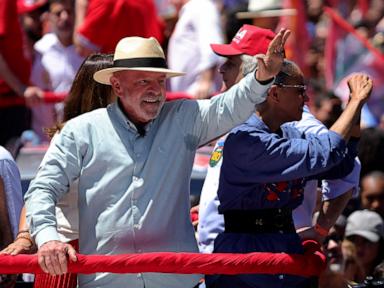
Millions of Brazilians are voting in an election featuring two main rivals: President Luiz Inácio Lula da Silva and Sen. Flávio Bolsonaro RIO DE JANEIRO -- Millions of Brazilians will vote Sunday in an election dominated by two rivals: incumbent President Luiz Inácio Lula da Silva and Sen. Flávio Bolsonaro, the son of ex-leader Jair Bolsonaro who Lula defeated four years ago.
Twelve candidates are on the presidential ballot, but only Lula and Bolsonaro are thought to have a real chance of becoming Brazil’s next head of state. If no candidate receives more than 50% of the vote, the top 2 will advance to a runoff on Oct. 25. Lula, who at 80 is one of the world’s oldest heads of state, is running in his seventh presidential election.
Bolsonaro, 45, is competing in his first and seeking to return his family name to power after his father governed Brazil from 2019 through 2022. The two represent opposite sides of the political spectrum, with conflicting visions on issues ranging from how to tackle organized crime to the relationship Latin America's biggest country should have with the Trump administration. Here’s what to know about Brazil’s election.
Brazil holds general elections every four years, and voting is mandatory. Those who fail to cast a ballot without justification face a small fine. On Sunday, Brazilians will choose a president, state and federal representatives as well as governors and some senators.
Elections for mayors and city councilors are also held every four years, but in different years. Almost 160 million eligible voters will use electronic voting machines to punch in the digits corresponding to their candidates, preparing number-heavy lists. Brazilian authorities adopted electronic voting machines in the 1990s to combat fraud.
In earlier local elections, ballot boxes were stuffed or stolen, and paper ballots were routinely falsified, according to Brazil’s electoral authority. The country held no direct presidential elections between 1960 and 1989, a period that included military rule from 1964 to 1985. Now, results are reported mere hours after polls close.
Extract — continue reading at the source.