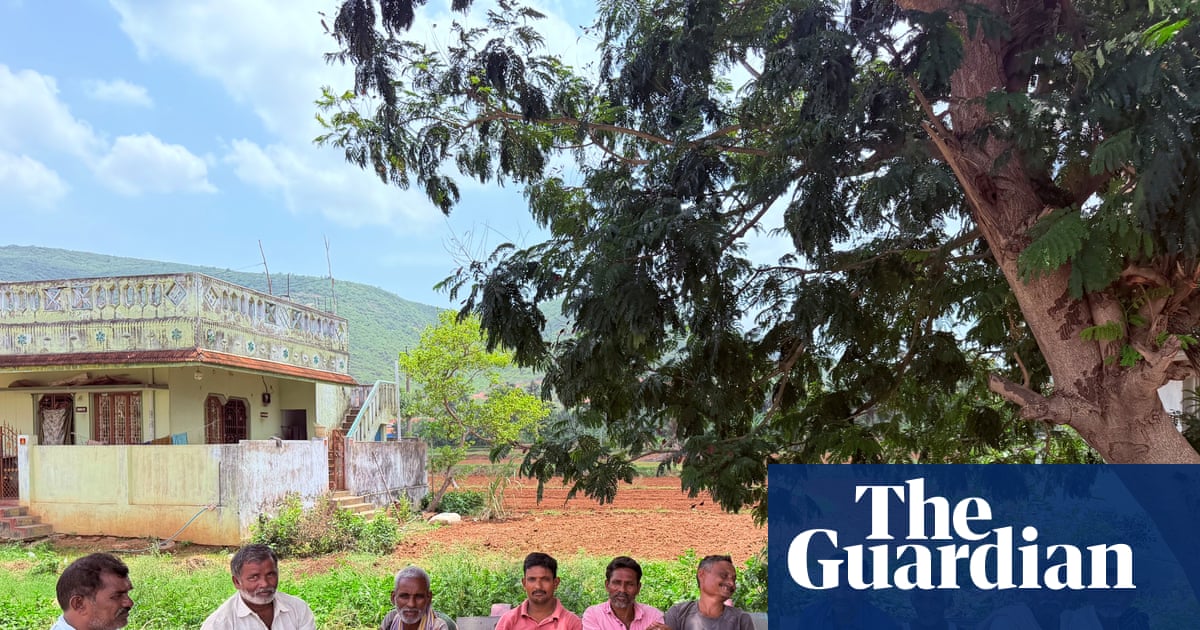
When the government officials arrived in Tarluvada last year, they came with abundant promises. Google, one of the world’s richest and most powerful tech companies, would soon be bringing a “golden opportunity” to this tiny village in south India: a $15bn AI datacentre. The project, being built in the Indian state of Andhra Pradesh, is set to be Google’s largest “hyperscale” AI datacentre outside the US and would, officials said, make the village of Tarluvada into a world-famous tech hub.
Jobs, usually scarce in this impoverished community, would become bountiful, real estate prices would soar and compensation for any land would be generous. Few in the village – which sits on a dusty unpaved road and is surrounded by farms and forest – had even heard of AI or knew what a datacentre was. Yet it did not take long for local jubilation over Google’s arrival to turn to suspicion.
Just as protests have erupted globally over AI datacentres – from California and Texas to Scotland and Australia – communities in Andhra Pradesh, too have been gathering in opposition to the project, fearing that the people will end up bearing a crippling environmental and economic cost. But the government has refused to answer our questions.” Pointing up to the nearby hillside – where bulldozers recently stripped the land bare of trees to ready it for Google’s mega AI campus – Naidu adds: “The work just continues every day.” The state government, which is allied with Indian prime minister Narendra Modi’s party, have been accused of trying to obfuscate the true scale of the vast AI hub being built in Andhra Pradesh, to push the project through at lightening speed and avoid more stringent environmental scrutiny. Google has partnered with the Adani Group, one of India’s largest and most politically powerful conglomerates with a reputation for getting approvals through quickly, to build the project.
Publicly it was announced as a 1GW project – already a larger energy requirement than most AI datacentres. In its response to the Guardian, Google referred to it only as an unspecific “gigawatt scale AI hub”, that was “comparable to other projects”. But state environmental clearances reveal that permission has been granted for it to be more than double that size – 2.51GW; the power equivalent of two large nuclear reactors at full output.
Over a year, it amounts to upwards of 30% of the current energy consumption of the whole of Andhra Pradesh, a state home to more than 55 million people. Activists fear that meeting the datacentre’s vast energy demands will lead to seismic environmental consequences for the region, including driving up fossil fuel emissions. While Google has pledged to help generate “new, clean energy” to power its AI hub, currently 75% of the country’s electricity grid is run on coal.
The state government argues AI datacentres will be essential to India’s growth and long-term digital competitiveness. According to the government of India’s Economic Survey 2025–26, India generated nearly 20% of the world’s data but hosts only about 3% of global datacentres. But locals and activists say that building one of the world’s largest AI datacentres in a region of India already struggling with issues over extreme heat, water, land, forests, power shortages and environmental regulation comes at a heavy cost.
Extract — continue reading at the source.