The icon indicates free access to the linked research on JSTOR. The Germans began firing on Paris again on the fifth of August 1918. Mary Josephine Booth was familiar with the sound of the air raid sirens by then.
If they came at night, she would jump out of her bed at the Hotel Petrograd, dress, take what valuables she had, and if the shelling was especially fierce, retreat to the basement. But if the sirens came during the day, then Booth, clad in her olive-green uniform, would remain at her post in an ornate building across the street from the Palais de L’Élysée. Booth was one of hundreds of librarians who went to war alongside American troops during the First World War.
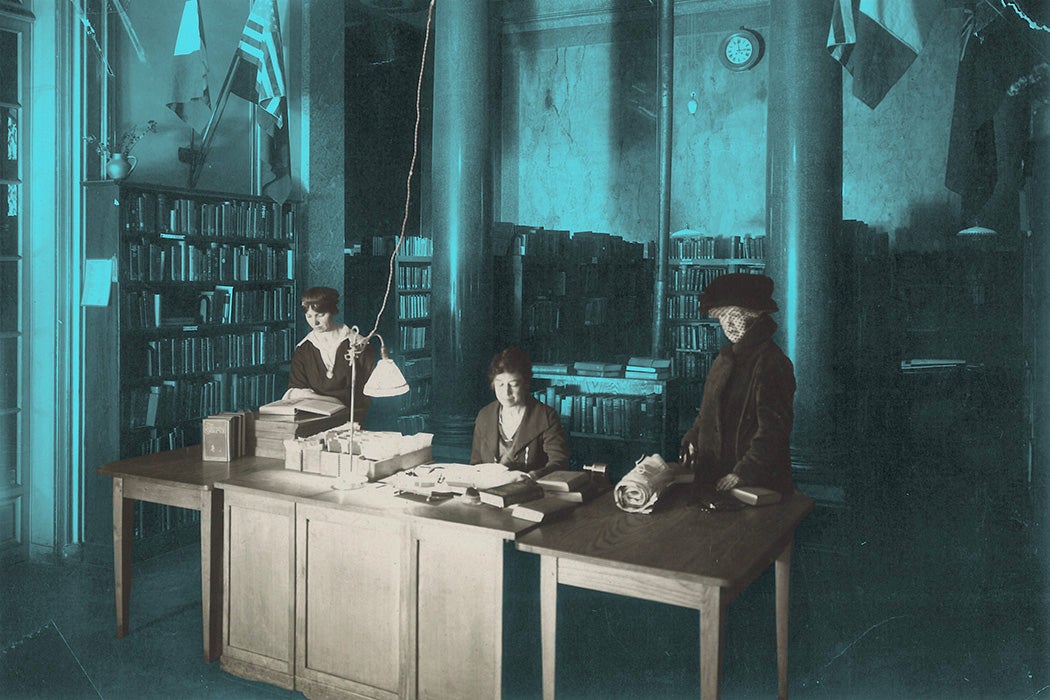
In the summer of 1918, the 42-year-old woman from Illinois served with fellow recruits to the American Library Association’s Library War Service as they prepared to open an American library in the war-scarred French capital, pictures of which are now available from the American Library in Paris via JSTOR. Booth helped with unpacking and sorting the countless books that arrived from the home front, cataloguing titles for the new library (a project made more challenging by the lack of a Dewey Decimal reference guide) and selecting which would be sent to “our boys in the front trenches.” Books at the ALA Dispatch Office Widener Branch in Philadelphia being readied to be shipped abroad for the Library War Service, ca. 1918. Click on the image to take a closer look.
When the United States entered the conflict, the American Library Association had not been well known. In fact, among other organizations doing war relief work, the ALA was, on occasion, mistaken for the American Laundry Association and the Australian Light Artillery. By 1920, the group would raise $5 million from the American public, build 36 camp library buildings, and distribute more than 10 million books and magazines to soldiers stationed at 5,000 locations across the United States and Europe.
Personnel processing library materials at the ALA Central Library Shipping Department, likely at 10 rue de l’Élysée, ca. 1918. Booth seemed like a natural fit for the Library War Service. She was a graduate of the Illinois State Library School, had worked as a librarian at Eastern Illinois Normal School for more than a dozen years, and she was eager to join the war effort in Europe.
But the American Library Association did not initially warmly welcome women to the ranks of its war service. The organization saw the undertaking as an opportunity to masculinize the women-dominated profession, historian of librarianship Suzanne M. Only men “of real executive ability” were officially permitted to be camp librarians, as the presence of women “would interfere with the freedom of the men in their camp life” and would deter “red-blooded he-readers” from using the libraries.
Extract — continue reading at the source.



/https://tf-cmsv2-smithsonianmag-media.s3.amazonaws.com/filer_public/a8/a5/a8a5e093-276c-42c5-b311-5439a069f9c0/bubbles-lei-tracyolive.jpg)