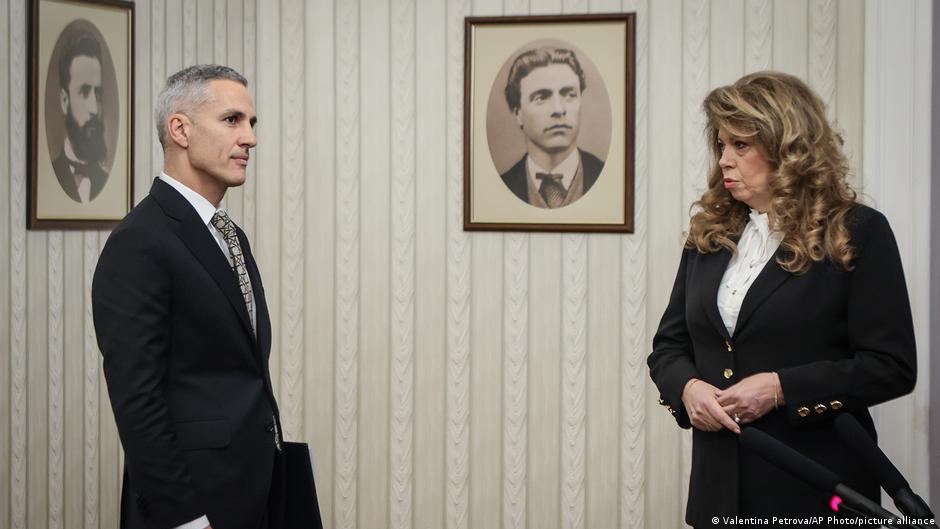
Six months after Bulgaria's parliamentary election, the country is gearing up to choose its next president. Although the role of president in Bulgaria is largely ceremonial, the election on October 25 — with a potential runoff on November 1 — will serve as a test for the government of former President Rumen Radev, whose party won a landslide victory in April, securing an unprecedented majority — the first in Bulgaria in almost three decades. Although there are 27 candidates on the ballot, the race has narrowed to a duel between the incumbent president, Iliana Yotova, who served two terms as Radev's vice president and is backed by the prime minister, and former caretaker Prime Minister Andrey Gyurov, who is supported by opposition parties.
According to the Bulgarian Constitution, the Bulgarian president embodies national unity. He or she represents the country at international level (with a few exceptions), is the commander-in-chief of its armed forces, appoints members of the Supreme Judicial Council and various regulatory bodies, including caretaker governments, and has the power to veto legislation. Hristo Panchugov, political scientist at the New Bulgarian University in Sofia, argues that although the president's powers are formally limited, the office is particularly significant in the current context.
"For the first time in Bulgaria's modern democratic history, we have an absolutely uncontested majority that is not held together by any coalition, but rather by a single political party that faces an opposition that is completely falling apart," he told DW. Panchugov went on to say that it would have been better if the campaign had focused more on "whether the president could serve as a counterbalance." Opposition candidate Andrey Gyurov reiterated this point in an interview with DW: "We are seeing a concentration of power that always bears the marks of a slide toward autocracy," he said, adding that "a president should know how to say no." Iliana Yotova declined DW's request for an interview. Initially, the presidential race was characterized by small rallies, a lack of televised debates and numerous personal attacks on the two leading candidates.
In recent weeks, however, following drone attacks on ships in the Black Sea, the two frontrunners' diverging positions on support for Ukraine have come to the fore. Bulgaria's government initially declined invitations to join the Coalition of the Willing and NATO's anti-drone initiative but changed its position on the latter after the recent drone attacks. Yotova advocates for the establishment of a "Coalition of Peace," where she says Bulgaria would have a stronger diplomatic voice in ending Russia's war in Ukraine.
"There are many warmongers in our country; I am not one of them," she said at a campaign rally this month, adding that "as long as I am president — and if you place your trust in me — not a single Bulgarian soldier will go to Ukraine." Yotova sought to reassure voters that no Bulgarian troops would be sent to Ukraine, even though this was not part of the public debate and despite a 2025 parliamentary declaration that reaffirmed that the Bulgarian Armed Forces would not participate in hostilities there. Nevertheless, the recent drone attacks on commercial ships in the Black Sea have put new pressure on both the president and Rumen Radev's Progressive Bulgaria party. "The drone strikes in the Black Sea brought the otherwise abstract geopolitical situation right into the daily lives of every Bulgarian," Boriana Dimitrova, managing partner of the Alpha Research market and social research agency, told DW.
Many in Europe, including Ukrainian President Volodymyr Zelenskyy, have laid the blame for the attacks squarely at Russia's door. The fact that Bulgaria's leaders did not clearly attribute blame for the attacks fueled frustration across the country. After the first drone attack, President Yotova convened the country's Consultative Council on National Security.
Extract — continue reading at the source.