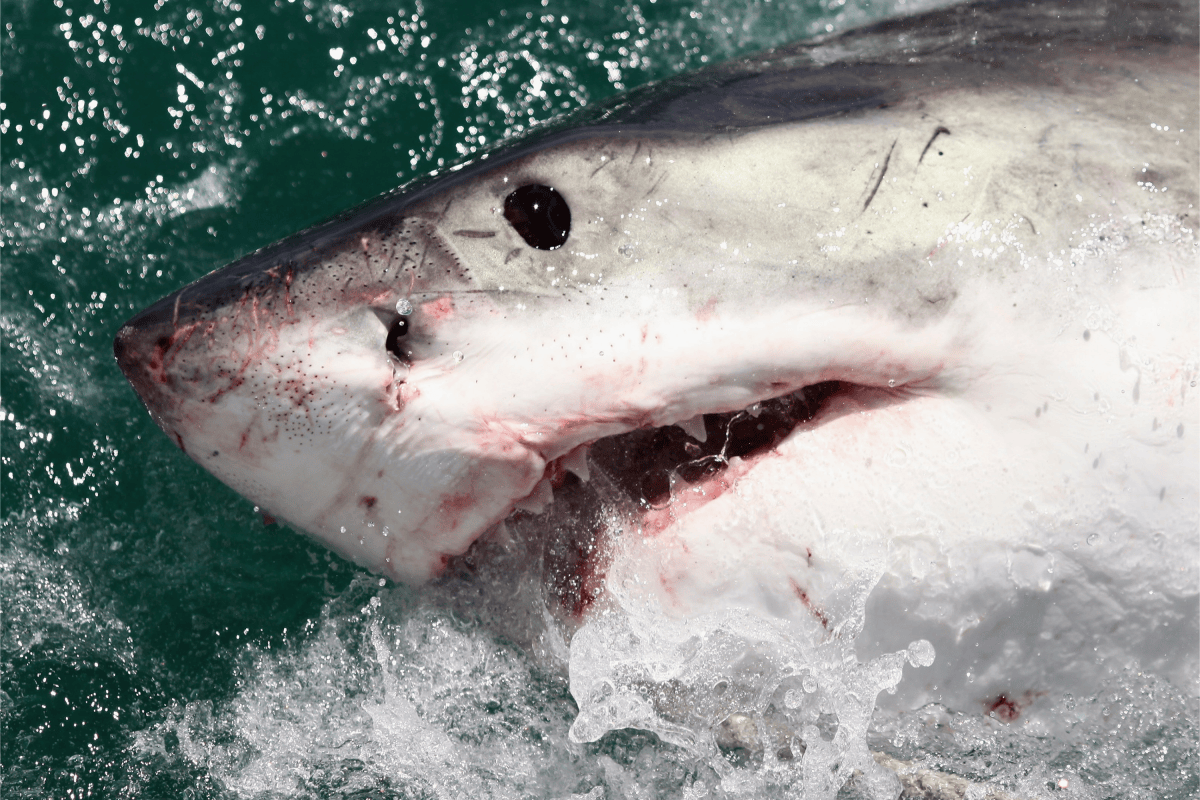
California officials are warning beachgoers to be extra careful after they detected more shark activity off the coast near Marina State Beach, days after dramatic footage of a great white shark suddenly breaching just meters from an unsuspecting beachgoer went viral. California State Parks told Newsweek that “shark advisories remain in place at Marina State Beach” and “drone footage confirmed additional shark activity in the area” on Tuesday, October 20. This warning aligns with reports from Sanctuary Cruises, a wildlife tour operator based nearby at Moss Landing, which captured footage of two huge great white sharks off the Marina coastline on Tuesday, providing further evidence that multiple sharks have been swimming in the waters around the popular beach.
Sanctuary Cruises said that exceptionally calm conditions prompted its crew to travel toward the Marina coastline, where it saw two great white sharks “cruising just beneath the surface.” The company said light winds and "mirror-flat" water gave them an incredibly clear view of the sharks. It also explained that surface water temperatures were about 66 degrees Fahrenheit and that Marina Beach’s shallow, sandy shelf provides ideal conditions for white sharks before winter changes coastal patterns. Marty Greenstein, deputy director of communications and marketing at California State Parks, told Newsweek that "State Parks advises visitors to check with staff before entering the water,” urging beachgoers to “be cautious of your surroundings, and to report any shark sightings,” before adding that “interactions between people and sharks are rare." State Parks has previously closed its beaches following shark attacks.
After a fatal shark attack at Manresa State Beach in 2020, for example, the agency closed a section of water that stretched one mile north and one mile south of the incident for five days and posted warning signs at beach access points. The latest sightings suggest the viral breach wasn’t the only recent shark activity around the Marina coastline. October is a period of time that Californians, especially divers and surfers, call "Sharktober," due to the sharp increase in shark activity along parts of the California coast.
Experts say that during the fall, adult great white sharks tend to return to the California coast after spending six to eight months hanging out at the “White Shark Cafe,” an area in the open Pacific. Despite their fearsome reputation, shark attacks remain extremely rare in California. A study by California Department of Fish and Wildlife researchers identified 201 verified shark incidents in California waters between 1950 and 2021, 178 of which involved white sharks.
Of the total, 107 resulted in injuries, and 15 were fatal. Scientists have suggested that some white shark bites might be a case of mistaken identity. Research into the animals' vision has found that swimmers and surfers viewed from below can resemble seals and sea lions, while subsequent experiments have found that altering the silhouette of seal-shaped decoys can significantly reduce attacks by white sharks.
In a 2024 study published in Cell, researchers tested this theory by towing seal-shaped decoys fitted with lights beneath them, which were designed to change the seal-shaped silhouette when it was viewed from below. They found that the sharks frequently attacked unlit decoys, but became less likely to approach or strike those that were illuminated. For now, officials are urging Californians who are considering entering the water, particularly around Marina and its nearby beaches, to check conditions with park staff first, remain alert, and report shark sightings.
Extract — continue reading at the source.