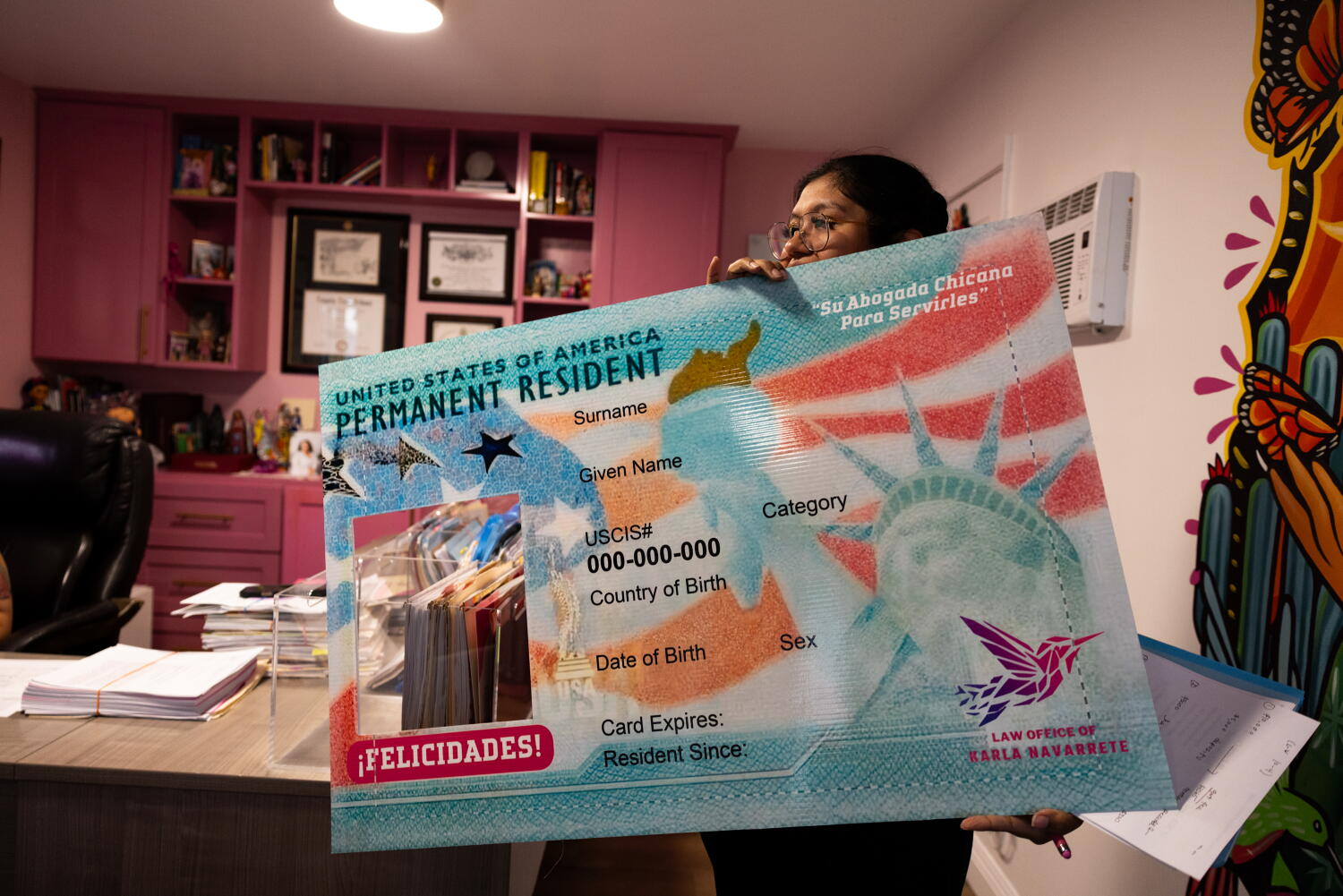
California and other Democratic-led states and localities filed a pair of lawsuits Monday challenging new Trump administration rules giving immigration officials more power to deny green cards to applicants whose families have relied on public assistance programs in the past. The challenge mirrors another by a similar coalition that successfully halted such changes during the first Trump administration. Rob Bonta, whose office is helping lead the states’ challenge, said the rule changes seek to “rewrite more than 100 years of law” by making even brief use of public benefits in years past grounds for the federal government to deny a person’s application for legal permanent residency in the future — which he said was clearly illegal and would push tremendous costs onto states, counties and cities.
David Chiu, whose office is helping lead a separate challenge from Democratic-led cities and counties, said in a statement that the new Trump administration policies are “a blatant attempt to sow fear and confusion in our immigrant communities and coerce people into withdrawing from critical government services” — which he also said would shift millions in costs to local governments. A spokesperson for the Department of Homeland Security, which promulgated the new rules, said the lawsuits were proof that immigrants are unlawfully tapping into benefits programs intended for U.S. citizens. President Trump won office on a promise to rein in illegal immigration.
Since taking office, his administration has launched a mass crackdown that has targeted both undocumented and documented immigrants. It has done so in part by targeting federal and state programs that offer immigrant assistance — which Trump has derided as diverting resources away from U.S. citizens. In their lawsuit, the states acknowledge that federal law enacted by Congress in 1882 allows the U.S. to deny noncitizens entry to the country if they would be a “public charge,” or someone who is unable to support themselves and must rely on the government for assistance.
However, the states argue that Congress, the courts and federal government agencies have for “over 140 years” understood the term “public charge” to mean a person “who has become, or is likely to become, primarily dependent on the government for long-term subsistence” — not someone who has ever taken public assistance of any kind in the past, even in the short term. And yet, the new policy promulgated by Homeland Security and U.S. Citizenship and Immigration Services gives immigration officers “unprecedented, sweeping new discretion to deny admission” to families that have tapped any number of public assistance programs for which both Congress and individual states have chosen to make them eligible, the states wrote.
The lawsuit, joined by Bonta, the attorneys general of 19 other states and the District of Columbia, and the governor of Pennsylvania, was filed in federal court in New York. A separate lawsuit was filed in the same court by San Francisco and Santa Clara County in California, as well as New York City, Chicago, and Seattle and surrounding King County, Wash. In a morning news conference, Bonta said the Trump administration’s new rules target families in unprecedented ways.
As one example, he said the new rules would potentially allow immigration officials to deny permanent residency to immigrant parents based on their U.S. citizen children accessing public benefits that they are clearly entitled to under the law. As another, he said the new rules could penalize immigrant families for accessing basic, preventative healthcare that actually helps control the broader public cost of illness to localities and states. Chiu said federal limits on residency for those who would be a “public charge” have in the past been applied in a “narrow and consistent way,” focusing on certain cash assistance and long-term medical needs.
Extract — continue reading at the source.