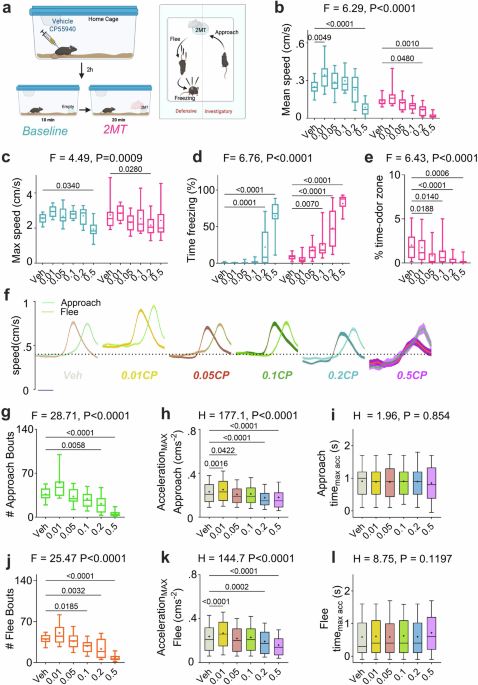
Cannabinoids precipitate anxiety and panic reactions in humans and can increase threat-related defensive responses in rodents in a dose- and context-dependent manner. Despite these well-established findings, how cannabinoids affect in vivo neural dynamics associated with threat-related behavior has not been examined. Here, we show that cannabinoids dose-dependently augment threat-induced defensive responses and the activity of central amygdala (CeA) somatostatin neurons (SOM) in mice, which are required for cannabinoid augmentation of threat avoidance, but not freezing.
Moreover, enhanced antagonistic behavior-linked sub-ensemble generation, threat-related location and behavior representation, and multidimensional representation, were also observed after cannabinoid treatment. While cannabinoid receptor activation ex vivo suppressed excitatory inputs onto SOM neurons, our data suggest preferential suppression of local GABA release subserves cannabinoid activation of CeA SOM neurons. These data provide insight into how cannabinoid-mediated presynaptic suppression transforms postsynaptic population dynamics to reveal cellular mechanisms by which cannabinoids could affect threat-induced defensive responses.
Plant-derived cannabinoids, including tetrahydrocannabinol and synthetic analogs, are widely used for medicinal and recreational purposes and exert broad-ranging behavioral and physiological effects on mood, anxiety, memory, appetite, and sleep via activation of cannabinoid type 1 (CB1) receptors in humans and rodents1. CB1Rs are Gi/o-coupled GPCRs that are widely distributed within the brain and spinal cord and expressed primarily on synaptic nerve terminals and to a lesser degree on postsynaptic membranes, astrocytes, and cellular organelles2,3,4. At synaptic terminals, activation of CB1Rs inhibits neurotransmitter vesicle release and mediates short- and long-term synaptic depression via multiple intracellular signaling pathways, while activation of CB1Rs on astrocytes may lead to synaptic potentiation via release of gliotransmitters2,3.
Within cortical-like brain regions, CB1 is expressed on a small subset of GABAergic interneurons that form perisomatic contacts with pyramidal neurons and exhibit prominent asynchronous GABA release5,6, and is more uniformly expressed at low levels within cortical pyramidal neurons within limbic areas, where they are trafficked to axon terminals5,7. Subcortically, CB1Rs are expressed in GABAergic neurons of striatal-like regions, including the nucleus accumbens and central amygdala (CeA), where they inhibit GABA release locally and in terminal regions8,9,10,11. CB2Rs have also been shown to regulate some neuronal process and neuroinflammation via modulation of microglial function12.
Despite these anatomical and synaptic data, how cannabinoid-mediated synaptic suppression ultimately affects neuron population activity, stimulus representation, and dynamics is not well understood. Of the broad-ranging behavioral effects of cannabinoids, modulation of anxiety and stress-reactivity are prominent and well-described13,14,15,16. Specifically, while tension and anxiety relief represent major reasons for cannabis use, paradoxical dose- and context-dependent increases in anxiety and panic are also well-documented, and some studies have suggested associations between cannabis use and the development and worsening of anxiety disorders14,17,18,19,20,21,22, especially in heavy cannabis users22.
From a mechanistic perspective, early investigations revealed strong activation of stress-reactive brain regions after cannabinoid administration. Specifically, cannabinoids increase Fos protein expression in the CeA23,24,25, a key neural substrate for anxiety, emotional learning, and stress-reactivity26,27,28,29,30. Cannabinoid-induced Fos expression in CeA neurons appears synergistic with concurrent stress exposure24,25, supporting the notion that CeA may be a relevant substrate for cannabinoid-stress interactions.
Extract — continue reading at the source.


