Early life adversity has a lasting impact on the endocannabinoid (eCB) system based on animal models. However, the impact of early life adversity, such as childhood trauma (CT), on the eCB system has not been thoroughly studied. We assessed the availability of cannabinoid receptor type 1 (CB1R) in individuals with CT compared to healthy controls without CT (HCs).
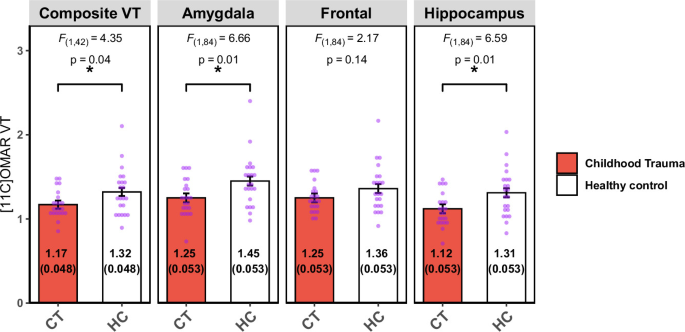
Cannabinoid receptor type 1 (CB1R) availability was compared in adults with CT (N = 22) and age- and sex-matched HCs (n = 22), using positron emission tomography (PET) imaging with the CB1R-specific radiotracer [11C]OMAR. Using linear models, the effect of the group was assessed on global and trauma-relevant brain regions (amygdala, hippocampus, and frontal cortex). Compared to HCs, lower CB1R availability was observed in CT globally (difference = −11.36%, F(1,42) = 4.35, p = 0.04), in amygdala (−13.70%, F(1,84) = 6.66, p = 0.01), and in hippocampus (−14.50%, F(1,84) = 6.59, p = 0.01), but not in frontal cortex (−8.08%, F(1,84) = 2.17, p = 0.14).
There were no effects of a diagnosis of posttraumatic stress disorder (PTSD), major depressive disorder (MDD), nicotine dependence, or the use of antidepressant medication. This preliminary result of lower CB1R availability in adults with CT compared with HCs suggests eCB dysregulation associated with CT. Future studies should replicate and extend this finding and examine the potential effects of various trauma features on the eCB system.
This is a preview of subscription content, access via your institution Receive 12 print issues and online access Prices may be subject to local taxes which are calculated during checkout The datasets generated and analyzed during the current study are available from the corresponding authors on reasonable request. Lippard ETC, Nemeroff CB. The devastating clinical consequences of child abuse and neglect: increased disease vulnerability and poor treatment response in mood disorders.
Am J Psychiatry. 2020;177:20–36. Sun J, Patel F, Rose-Jacobs R, Frank DA, Black MM, Chilton M. Mothers’ adverse childhood experiences and their young children’s development.
Am J preventive Med. 2017;53:882–91. Childhood trauma, posttraumatic stress disorder, and alcohol dependence. Alcohol research: Curr Rev. 2012;34:408.
Extract — continue reading at the source.