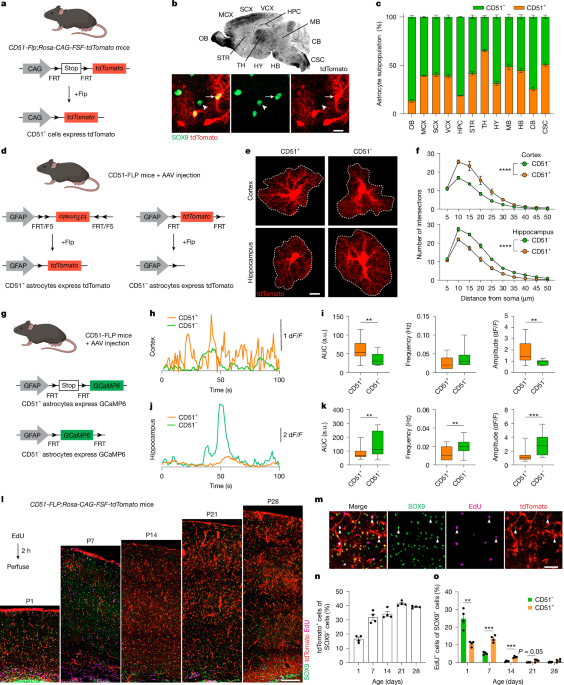
Astrocytes perform a diverse range of tasks that facilitate brain physiology, raising the possibility that these diverse astrocytic roles are enabled by functionally distinct subtypes1,2. Recent studies identified molecular diversity among astrocytes3; however, whether this molecular heterogeneity reflects specialized astrocyte subpopulations with distinct functions remains unclear. Here, on the basis of previous molecular and functional studies4, we generated a CD51-FLP mouse line that enables direct comparison of the functional properties between CD51+ and CD51− astrocyte subpopulations in neural circuits in vivo.
We show that CD51+ and CD51− astrocytes have unique morphological, physiological and developmental properties in both the cortex and hippocampus. Functional studies demonstrate that CD51+ astrocytes selectively promote synapse formation in the developing cortex and circuit plasticity in the hippocampus. Mechanistically, we found that CD51+ astrocytes function through glypican 6 to promote synapse formation in the cortex, while CD51 itself drives circuit plasticity in the hippocampus.
Applying these findings to brain injury, we found that CD51+ astrocytes promote functional recovery after stroke through enhanced synaptic remodelling. Taken together, our studies identify specialized astrocyte subpopulations that exhibit distinct functional properties in the developing, mature and injured brain. Cellular diversity is an operational necessity of all organ systems, in which diverse cell types participate in a division of labour that orchestrates essential physiological activities.
Astrocytes are the most abundant type of glial cell in the central nervous system (CNS) and have vital roles in all facets of brain physiology, including neurotransmission, synaptogenesis, circuit function, metabolic support and maintenance of the blood–brain barrier, along with responses to injury and degeneration1,5,6,7. Advances in single-cell RNA-sequencing (scRNA-seq) technologies have facilitated the identification of several prospective astrocyte subpopulations, suggesting that these diverse roles may be conducted by subsets of distinct astrocytes8. However, whether specialized astrocytes are capable of executing a subset of these diverse functions remains very poorly defined, as experimentally examining the extent to which molecular heterogeneity reflects functionally distinct subtypes of astrocytes in active neural circuits remains a major challenge.
While several previous studies identified astrocyte populations that express unique markers and demonstrated roles for these specific genes in astrocytes in the context of neural circuits, whether these populations have unique functional properties remains unclear9,10. Unambiguous demonstration of functionally distinct astrocyte subpopulations at the cellular level requires a direct comparison of the functional properties between two populations in vivo. Critically, tools that enable selective labelling and manipulation of defined subsets of astrocytes, which would facilitate the direct comparison between different subpopulations of astrocytes, do not exist.
Thus, whether functionally distinct subtypes of astrocytes exist in neural circuits has remained unresolved. Here we identify CD51+ and CD51− astrocytes as subpopulations with distinct properties and diverse functions in regulating neural circuits across postnatal cortical development, learning and memory, and brain repair. Using fluorescence-activated cell sorting (FACS)-based approaches in the adult mouse brain, our previous studies identified CD51, the αV integrin subunit encoded by Itgav, as a cell surface marker capable of subdividing subsets of astrocytes with unique molecular properties4.
Extract — continue reading at the source.


