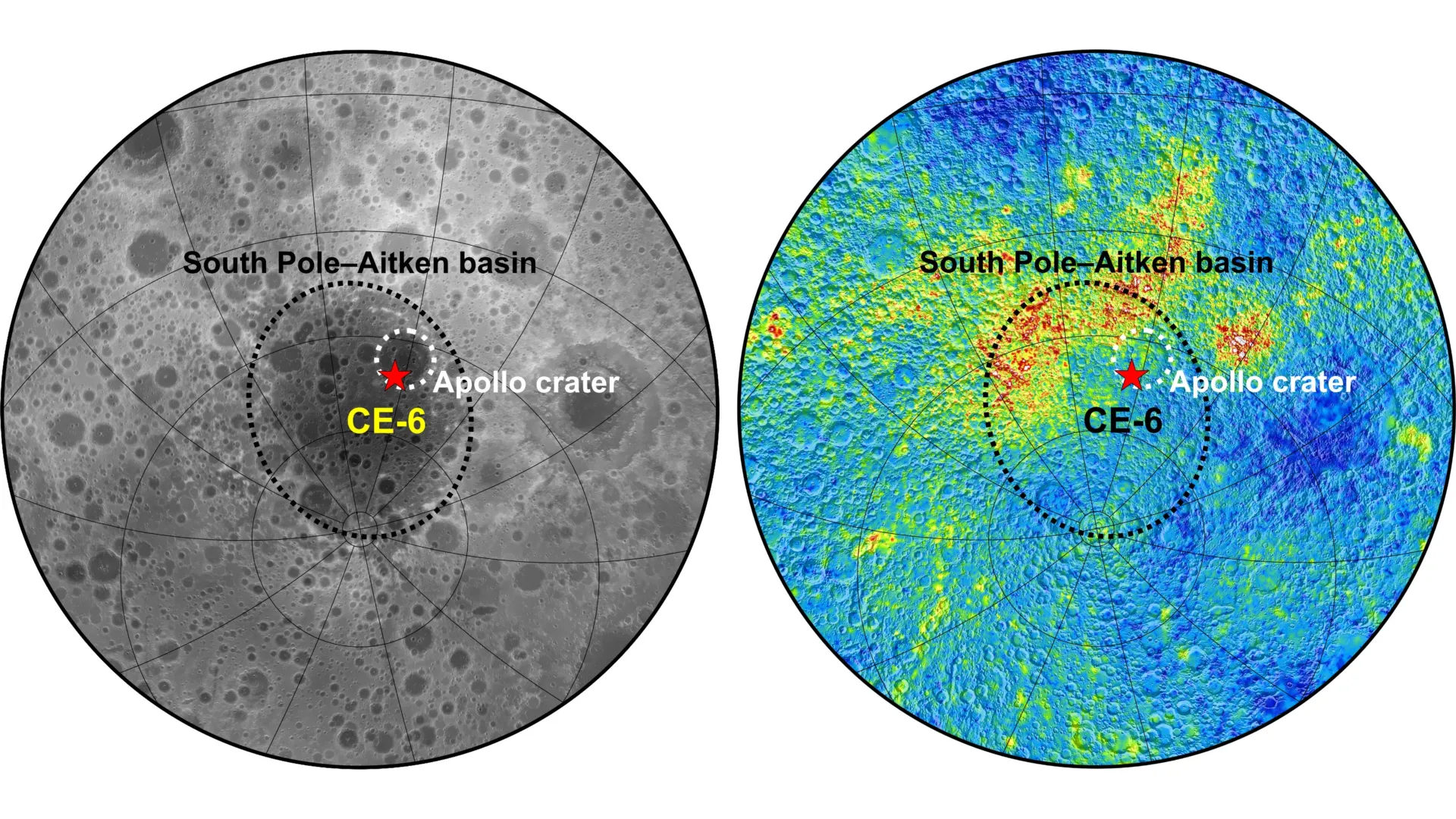
The Moon no longer generates a global magnetic field, but traces of its ancient magnetism remain locked inside lunar rocks and soil. By studying the magnetic minerals preserved in these materials, scientists can reconstruct how the Moon's magnetic environment changed over time. Researchers analyzing metallic iron inside impact glass from Chang'e-6 lunar soil have now identified face-centered cubic γ-Fe for the first time in natural lunar samples.
The study was led by Prof. Haifeng Du of the High Magnetic Field Laboratory at the Hefei Institutes of Physical Science (HFIPS) of the Chinese Academy of Sciences (CAS). The findings were published in the Proceedings of the National Academy of Sciences (PNAS) on September 16.
"This tiny magnetic fossil may help us better understand the Moon's ancient magnetic history," said Dr. Long Li from HFIPS, a member of the team. To examine the samples, the researchers used focused ion beam preparation, transmission electron microscopy, and chemical analysis.
These techniques revealed numerous nanoscale iron particles embedded throughout the glassy material. Closer examination showed that some of the particles consisted of face-centered cubic γ-Fe. In fact, γ-Fe was the dominant form of iron in the two impact-glass samples studied.
Under normal conditions, γ-Fe is stable only at high temperatures. As the material cools, it typically changes into another form known as α-Fe. The researchers found evidence that the unusual conditions produced by impacts on the Moon may allow γ-Fe to survive at the lunar surface.
They proposed that several factors could help stabilize the structure, including small amounts of carbon and other elements, the rapid cooling of molten material created during an impact, and protection from the surrounding glassy matrix. Tiny Particles That Can Preserve Magnetism The team also used off-axis electron holography to investigate the magnetic behavior of individual γ-Fe nanoparticles. They found that relatively large γ-Fe particles could form a stable single-vortex magnetic state.
Extract — continue reading at the source.