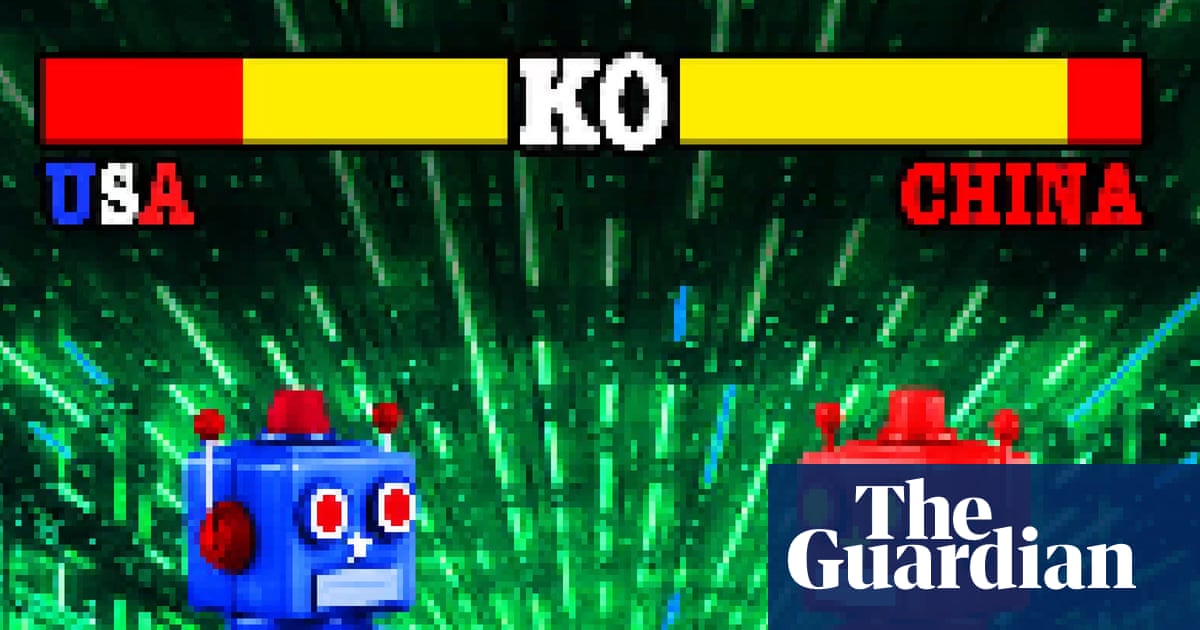
When reporters asked Donald Trump this week if he supported calls to slow down the development of artificial intelligence out of growing fears for cybersecurity, public safety and the fate of humanity, he said no. The US is in a heated technological race with China, companies including Anthropic and OpenAI have argued, and any regulation that would cede the contest risks incalculable economic and political harm. Even as Dario Amodei, Anthropic’s CEO, led an industry-wide call this week to “pace the frontier”, he declared that the US could only slow down to the point where China could not catch up.
The AI industry’s concerns about China may come with self-serving economic incentives, but they also reflect a strain of hawkish foreign policy toward Beijing that has become entrenched in tech. In recent years, parts of Silicon Valley have positioned themselves as the vanguard in a new cold war with China, arguing fiercely that the industry’s technological advancements are essential to both US hegemony and the liberal world order. This view has taken hold across tech’s different ideological camps, creating strange bedfellows of AI safety advocates, techno-militarists and neoconservatives, all of them fearful of Beijing.
AI companies have hired former top US government staffers from both the Biden and Trump administrations to shape public strategy and analyze geopolitical risk, setting up in-house policy teams. Influential tech leaders have meanwhile written essays and policy documents calling for efforts to deter and degrade China’s AI capabilities, sometimes advocating for threatening armed conflict if necessary, in an attempt to influence foreign policy. As public calls for reining in the AI industry intensify and the risks associated with the technology increase, various industry forces are trying to ensure they are the ones with the answer to the question “what about China?”.
Anthropic and OpenAI did not respond to requests for comment for this article. Few have been more vocal about the threat of Chinese state-controlled artificial intelligence than Amodei. The Anthropic CEO has argued for years that one of the reasons he’s so animated to advance AI is to ensure that the technology falls into the hands of Democratic governments and not oppressive regimes such as China.
Amodei’s position has made him one of Silicon Valley’s most vocal critics of China’s tech industry, separating him from fellow AI leaders such as OpenAI CEO Sam Altman or Meta founder Mark Zuckerberg, who frame the competition more in corporate or economic terms; and people such as Jensen Huang, Nvidia’s CEO, who have encouraged the use of Chinese AI models. Demis Hassabis, the leader of Google Deepmind, has made few public remarks on China in comparison with his peers. Anthropic is a totally different story,” said Kyle Chan, a fellow at the Brookings Institution.
Amodei’s argument, which he has laid out over a series of essays, is that China acquiring superpowered AI is one of the most severe threats posed by the technology. He believes humanity is approaching the creation of an ultra-advanced AI, and that such a tool would give an authoritarian state the ability to create a “swarm of millions or billions of fully automated armed drones” that would be “capable of both defeating any military in the world and suppressing dissent within a country by following around every citizen”. Amodei has long asserted that in order to stop China’s advancement, the US and its allies should take aggressive action to limit Chinese AI companies’ growth – most notably blocking the sale of advanced semiconductor chips and manufacturing equipment necessary for improving AI. (Huang of Nvidia has bristled at this position, calling export controls a failure and urging Trump to ease restrictions.) But Amodei’s position was perhaps most on display last weekend, in his response to warnings from a young Anthropic researcher who resigned, predicting human extinction by the end of the decade at the digital hands of AI.
Extract — continue reading at the source.