China’s Jingdezhen porcelain sites were inscribed on UNESCO’s World Heritage List in 2026 JINGDEZHEN, China -- Chinese porcelain artist Chen Qing has a vivid memory of her grandfather. It was the only time he wrote down the formula for her family’s distinctive red pigment. He asked her mother to memorize it and burned the paper minutes later.
The secret has since been passed down orally from one generation to the next. Her family has practiced the craft since around 1860 in Jingdezhen, known as China’s “Porcelain Capital.” It is located in Jiangxi province, about 1,180 kilometers (735 miles) southeast of Beijing. Jingdezhen’s pottery-making history spans more than 2,000 years.
It began during the Han Dynasty and its porcelain sites were inscribed on UNESCO’s World Heritage List in 2026. Jingdezhen’s craftsmen have kept alive techniques once used to produce porcelain for the imperial court. That knowledge later spread to private artisans.
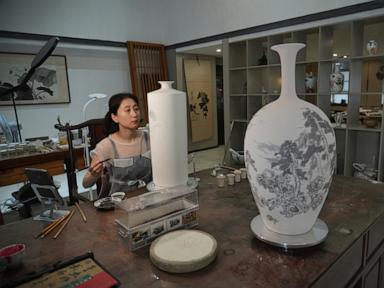
Chen’s ancestors adopted some of those traditions after the fall of the Qing Dynasty in 1912. She works in silence, a lamp lighting her strokes. Chen’s fingers never touch the porcelain’s surface.
She steadies her hand against its outer edge, holding the brush firmly as she paints delicate, precise strokes. Painting a porcelain teacup can take days to complete. A single particle of dust or sweat could ruin the piece and require her to start from scratch.
Landscapes are the most difficult scenes to paint because their boundaries are not clear. A mountain summit might be emerald green, gradually shifting to brown and other warmer colors farther down the slope. Jingdezhen’s Imperial Kiln Institute researches and restores ceramics excavated from an adjacent complex, where pieces for emperors were crafted in kilns whose remains are still visible today.
Extract — continue reading at the source.