The weather on distant planets can tell us a lot about them, including how they formed, what they’re made of, and how likely it is that we might find life there. However, there’s not much meteorological information to go on for celestial objects outside our solar system—they’re basically just flickers of light traveling across the vast emptiness of space. But in a recent study published in Astronomy & Astrophysics, researchers have detailed a new approach to decoding these flickers of light, giving us a better reading on both weather conditions and the drivers of those conditions on faraway worlds.
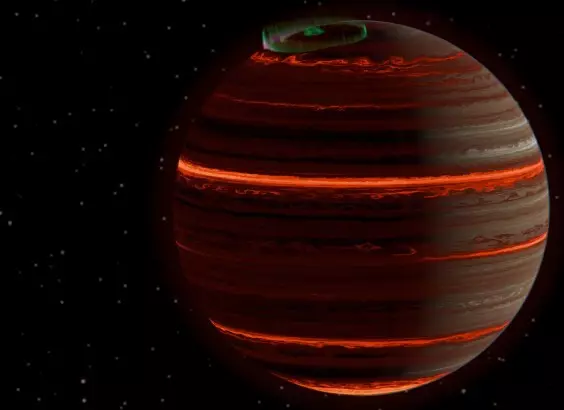
Read more: “Extreme Space Weather Could Delay Your Next Flight” The approach relies on an existing statistical technique called Principal Component Analysis (PCA), which was repurposed to analyze light coming from SIMP 0136—a brown dwarf that formed like a star, but never ignited to become one. Assessing data captured by the highly sensitive instruments on board the James Webb Space Telescope, the research team used PCA and some atmospheric physics fundamentals to interpret the changes in light patterns emitted by SIMP 0136 as it rotates. The interpretation showed that weather conditions on the brown dwarf are driven principally by changes in temperature and vertical cloud structures, and they follow predictable routines based around a patchwork of hotter, thinner clouds and cooler, thicker clouds that extend vertically.
Not that you’d really want to be around to experience it: Temperatures on the sub-stellar object are thought to climb as high as 1,243 Kelvin, which is 1,778°F. SIMP 0136 is already well studied by astronomers. It’s around 20 light-years away in the Pisces constellation, and it’s thought to be around 200 million years old.
It’s 13 times the mass of Jupiter and is notable for being a rogue planet—a planetary mass object without a star to orbit around. Understanding more about its weather systems will be useful in the study of other brown dwarfs, as well as huge gas giant planets. Now that the new technique has been tested, it can be tried with other distant worlds, though SIMP 0136 is a relatively easy target in terms of obtaining the required raw data.
And if you think SIMP 0136 is extreme, your mind will be blown by what we know about other exoplanets, some of which boast rain of molten glass and climes so hot “scientists believe molecules there are being ripped apart into their constituent atoms.” Enjoying Nautilus? Subscribe to our free newsletter.
Extract — continue reading at the source.