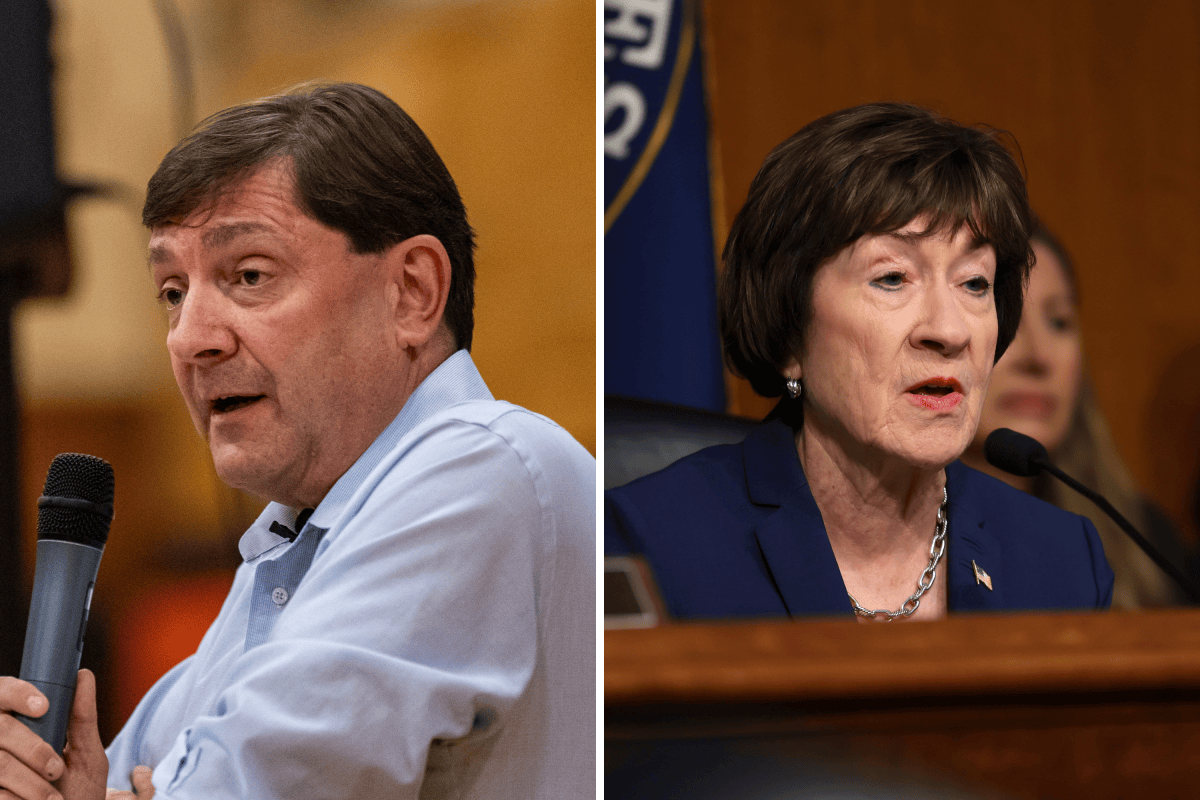
Republican Senator Susan Collins and her Democratic rival Troy Jackson squared off in the first of four planned debates that could shape Maine’s crucial Senate race. On Tuesday evening in Portland, the incumbent defended her voting record and her bipartisan bona fides as Jackson—who entered the race in late July—tried to draw political links between Collins and President Donald Trump while also pushing back against allegations of inexperience. Postdebate reactions online indicate that no consensus winner emerged.
However, both candidates had their own strong moments while leaving plenty to be said at the next encounter, scheduled for Thursday evening at 7 p.m. Democrats hold a polling advantage in the Senate, though these odds are far closer than in the House. With Maine’s Senate seat still in toss-up territory by most accounts, the contest is therefore being closely monitored alongside races in Ohio and Texas, among others.
The Pine Tree State historically leans Blue and voted against Trump in the 2016, 2020 and 2024 elections, though Collins has held her Senate seat since 1996, having cultivated a reputation as a moderate Republican and one committed to delivering for Mainers. The national environment for Republicans is tougher in 2026, however, given the low approval ratings enjoyed by Trump, though Collins has tried to distance herself from the president when it comes to new tariffs on Canada and on other matters. Though numerous issues were covered, the debate focused largely on the question of whether Collins should be viewed as a moderate Republican capable of advocating for the state’s interests, or—as Jackson alleges—a stalwart supporter of Trump’s agenda even at the expense of ordinary Mainers.
Jackson’s attempts to nationalize the race included connecting Collins’s 2018 vote to confirm Supreme Court Justice Brett Kavanaugh with the eventual overturning of Roe v. Wade, and attempting to tie her to the Iran war and Trump’s tariffs on Canada—of which a majority of Mainers disapprove. Collins, in response, noted her votes to assert Congress’s authority over the war.
She called herself "the most outspoken opponent of the tariffs with Canada" while mentioning her efforts to protect Maine businesses from the worst effects of Trump’s duties. In one of the most commented-on exchanges, Collins said that she was able to secure a tariff exemption for road salt from Canada, to which Jackson responded: "We can’t eat road salt." Collins also pushed back against the statistic—frequently quoted by the Jackson campaign—that she votes with Trump 96 percent of the time. Collins said that the "misleading" statistic, which was quoted in the Bangor Daily News, failed to account for all her votes and that the actual figure was 70 percent.
VoteView identifies Collins as one of the most centrist Republican senators by congressional roll call votes in the 119th Congress. Collins further attempted to distance herself from Trump saying that she was "not exactly his favorite senator" when asked whether the president would stump for her on the campaign trail. Postdebate reactions did not paint a clear consensus winner, with most commentary splitting along party lines.
Extract — continue reading at the source.