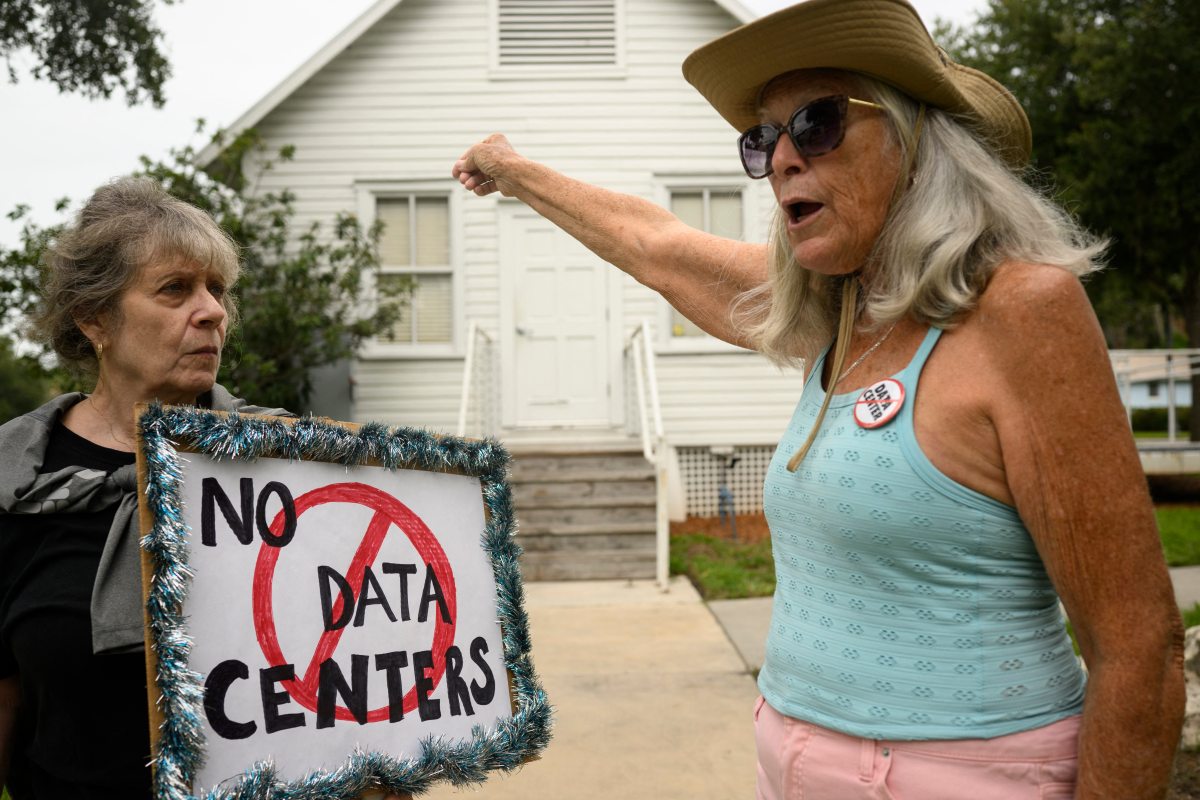
The Senate is expected to take up the Ratepayer Protection Act this week, bipartisan legislation that promises to safeguard U.S. households and small businesses from higher utility bills driven by the energy demands of AI data centers. The bill already passed the House with overwhelming support on September 16, with 417 lawmakers voting to push it forward and only three opposing it. This broad endorsement reflects lawmakers’ desire to respond to Americans’ concern over data centers, as public opinion has recently turned against the power-hungry facilities due to soaring electricity bills, local water shortages and pushback over the constant humming and whirring caused by heavy-duty cooling fans and backup generators.
With only a few weeks to go before the midterms, the passing of the bill would help Senator Jon Husted of Ohio in particular, who authored the proposal in the upper chamber, as the Republican lawmaker is facing fierce attacks from his Democratic opponent in November, former Senator Sherrod Brown of Ohio, on the issue of data centers. "Jon Husted led the charge to bring data centers to Ohio, forcing Ohioans to pay thousands more in higher electric bills and giving giant out-of-state corporations billions of dollars in out-of-control tax breaks," Lauren Chou, a spokesperson for Brown’s campaign, said in a statement to POLITICO. "Ohioans should get to decide if data centers are built in their communities and should never be forced to subsidize the electricity costs of big corporations." The Senate already refused to approve the Ratepayer Protection Act under unanimous consent earlier on September 17, as Senator Martin Heinrich of New Mexico, the top Democrat on the Senate Energy and Natural Resources Committee, said the measure does not go far enough to protect U.S. consumers.
"Congress needs to pass real legislation with real teeth," he said. Another legislative solution, the GRID Savings Act, introduced by Heinrich in July 2026, would require very large electricity users—such as AI data centers consuming 150 MW or more—to pay for the grid upgrades needed to connect them. It would also give FERC clearer authority over these connections and establish standards for studies, timelines, phased service, and cost allocation.
Others have made similar criticisms of the proposed legislation, with Jim Walsh, policy director with Food and Water Watch, telling The Guardian that "the bill is posing as a consumer protection measure when in reality it will increase costs on consumers across the board." Below, Newsweek looks at everything we know about the impact of AI data centers on their local communities. The AI data center boom has been so rapid that their impact is still being assessed by experts. But the data available at the moment suggest that data centers and their energy demands are in fact contributing to higher energy bills for households living nearby.
The Environmental and Energy Study Institute (EESI) reports that electricity prices in the U.S. had been flat at around 13 cents per kilowatt-hour (kWh) for more than a decade before 2019, partially because of energy efficiency policies introduced during these years. But, by the end of 2025, average electricity prices in the nation had increased to 19 cents per kWh from 2019, or 27 percent higher. The reason for this increase, as suggested by EESI, is the request of 700 gigawatts of power connection development made that same year by data centers to dozens of utilities across the country.
An analysis conducted by Bloomberg found that in states with a high concentration of data centers like Virginia, electricity now costs up to 267 percent more for a single month than it did five years ago. Ultimately, the size and location of a data center determine how much it leans on the local grid and its impact on utility bills for affected communities. With more hyperscale data centers being built across the country, an increase in electricity use for local communities is almost inevitable, as these facilities "can use the same amount of electricity daily that a small or medium-sized city, around 80,000 houses, would use daily," explained Hannah Wiseman, professor of law at Penn State Dickinson Law.
Extract — continue reading at the source.