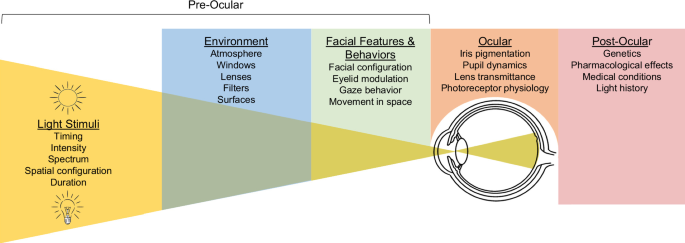
Guidelines for light measurement in laboratory studies of the non-visual effects of light have recently been put forward. Yet, outside of controlled environments, unique challenges necessitate additional consideration and modifications to those recommendations. The purpose of this paper is to build on prior work by outlining pre-ocular, ocular, and post-ocular factors and associated considerations that influence photic exposure and the physiological effects of light in the field.
Practical constraints of applying laboratory measurement guidelines and tools and strategies for light measurement in field-based work are discussed in detail, including the trade-offs of different approaches. A standard operating procedure for measuring light in field studies is provided, with particular attention to managing sources of variability, along with an example that applies the procedure to a recent study. Finally, future directions and remaining challenges of photic measurement during field studies of sleep, circadian rhythms, and other non-visual effects of light are identified.
Historically, lighting has been designed primarily to support the human visual system. Yet, there is a growing appreciation for how the effects of light extend well beyond illumination for visual perception. In addition to vision, light entering the eye significantly influences a range of physiological and behavioral processes, including the circadian timing system, neuroendocrine regulation, acute alertness, and mood1.
An increased understanding of these additional effects of light has driven the development of novel lighting strategies aimed at supporting both visual and non-visual photic responses in domestic and workplace settings, with the goal of improving health and safety outcomes2. Parallel advancements in lighting technologies and an increase in non-standard schedules have introduced greater variability in human photic exposure patterns. For example, light-emitting diodes (LEDs) can differ considerably in their physical properties, and exposure to light can vary considerably both within and between individuals.
Studying natural photic exposure patterns and evaluating the efficacy of lighting interventions requires precise and consistent description and quantification of light input, an undertaking that poses unique challenges in field settings. Inadequate measurement and reporting of light stimuli can result in misleading findings, hinder replication, limit comparability across studies, and ultimately slow the development of effective, integrated lighting solutions. While lighting standards and guidelines around vision have existed for decades, consensus-based recommendations have now introduced novel lighting metrics and standards that are specific to non-visual physiological effects of light3,4,5,6; however, implementing and validating these recommendations in real-world environments requires obtaining light measurements that reflect actual human photic exposure.
In 2019, a set of guidelines was proposed for measuring and reporting light in laboratory studies examining the physiological effects of photic exposure in humans7. A subsequent consensus-based framework built upon these recommendations, establishing a standardized process for obtaining light measurements in controlled laboratory settings8. These publications addressed a critical need for rigorous characterization of light in laboratory research.
Extract — continue reading at the source.


