Many firms publicize net-zero or carbon neutral targets, yet it is unclear whether consumers understand these targets. Policy proposals–as well as recent court rulings–call on firms to explain what those targets mean. We test whether such explanations enhance consumer understanding in two online studies with nationally representative U.S. samples (N=300; N=1,500) and in a large-scale webcam-based eye-tracking experiment (N=500).
Baseline knowledge is low: 95 percent of respondents fail to name even one defining feature of net-zero or carbon neutral targets, yet they are willing to pay a price premium for gift cards from companies with such targets. Concise disclosures raise objective understanding when a single product is shown, but none of the formats alter willingness to pay. In a more realistic setting with multiple products and competing cues, disclosures attract substantial gaze time, yet no longer improve comprehension; the visually salient color-coded format is associated with more misconceptions.
These findings contribute to the growing evidence that individual-level measures, such as information provision, may be a less effective response to systemic problems like global warming than previously thought. The push to limit global warming to \(1.5^\) C has prompted thousands of firms to announce climate targets. More than 3,000 corporations have already validated net-zero targets through the Science Based Targets initiative (SBTi), and the number of consumer-facing products marketed as carbon neutral grows daily.
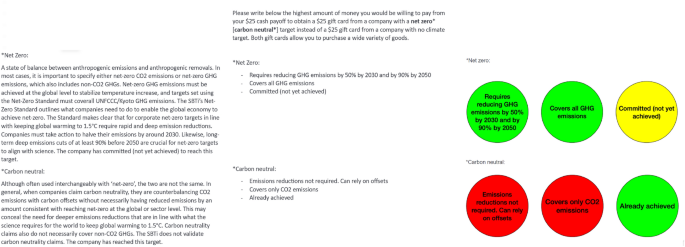
Key actors such as the SBTi, the International Organization for Standardization (ISO), and the United Nations (UN) agree on two fundamental distinctions between carbon neutral and net-zero targets. Net-zero requires deep, science-aligned cuts across all greenhouse-gas (GHG) emissions, with removals used only for the unavoidable residual. To become carbon neutral, by contrast, a firm can rely entirely on offsets and typically concerns \(CO_2\) alone.
However, recent evidence shows that consumers rarely understand the meaning of carbon neutral and net-zero targets, let alone the differences between them. Fewer than one in ten U.S. consumers can accurately describe what either target entails1. Surveys in the U.K. and Europe report similar results2,3.
Even though consumers do not understand the meaning of these targets, evidence suggests that they are willing to pay a premium for products or brands associated with them4,5,6,7. As a result, firms may exploit consumers’ limited understanding of climate targets by advertising targets that – while technically accurate – sound more ambitious than they actually are. Regulators and courts on both sides of the Atlantic are wrestling with how to address the information asymmetry between firms communicating climate targets and the consumers receiving them.
Extract — continue reading at the source.


