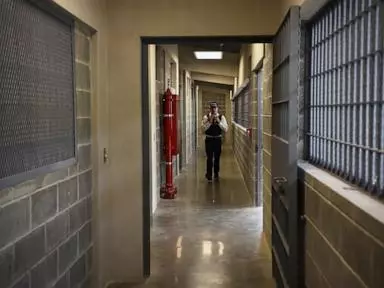
Costa Rica has made fighting drug trafficking a main goal, inspired by El Salvador's hardline approach SAN JOSÉ, Costa Rica -- SAN JOSÉ, Costa Rica (AP) — Costa Rica, considered for decades a peaceful enclave in turbulent Central America, has now made fighting drug trafficking one of its main goals. And it is turning to one of its Central American neighbors for inspiration in its hardline crackdown. On Wednesday, President Laura Fernández inaugurated a mega-prison that emulates the Terrorism Confinement Center (CECOT) that has become a symbol of Salvadoran President Nayib Bukele's security strategy.
Bukele has managed to reduce murders to a historic low in El Salvador but faces accusations of abuses during the state of emergency that began in 2022 and has imprisoned more than 91,000 people. Costa Rica is not the first to turn its attention to the man who has proclaimed himself the “coolest dictator in the world.” Ecuador has done it. So have the new presidents of Peru and Colombia.
From Honduras to the Southern Cone, these countries are joining the hardline security strategy also endorsed by U.S. Now, Costa Rica says it will incarcerate its most dangerous criminals in the High-Containment Center against Organized Crime, with a capacity for 5,100 inmates and a cost of $35 million. Here's how the country that was once the region's most stable got here.
For decades, Costa Rica was a “passive” transit zone for drugs from South America, according to the organization Insight Crime. But without an army, and with extensive jungle and ports on both coasts, it began to attract Mexican and Colombian cartels. At the end of the last decade, a new cargo terminal transformed the Caribbean port of Limón into a storage and transshipment point for cocaine destined for Europe, according to the U.S.
State Department, which, in a 2025 report, also detected fentanyl distribution in the Central American country. Now, the two major Mexican cartels, Sinaloa and Jalisco, are present in the country, as are the Colombian Clan del Golfo, the Venezuelan Tren de Aragua — all considered terrorist organizations by the United States — and Italian mafias, while local cartels proliferate, explained Vanda Felbab-Brown, an organized crime researcher at the Brookings Institution. The cartels’ interest in new routes and the rivalry between the two major Mexican cartels “pushed local proxies to fight with each other and then drove homicides up” in Costa Rica, Felbab-Brown noted.
Payments to these gangs in drugs developed local markets that further increased the violence, and the authorities felt overwhelmed. The alarm was raised in 2023 when the country registered a record 907 homicides — a figure that has decreased, but only slightly — and the government acknowledged that they were mostly due to organized crime. Insecurity, although far from that of Ecuador or Mexico, became the biggest concern for Costa Ricans and was a key factor in Fernández’s election.
Extract — continue reading at the source.