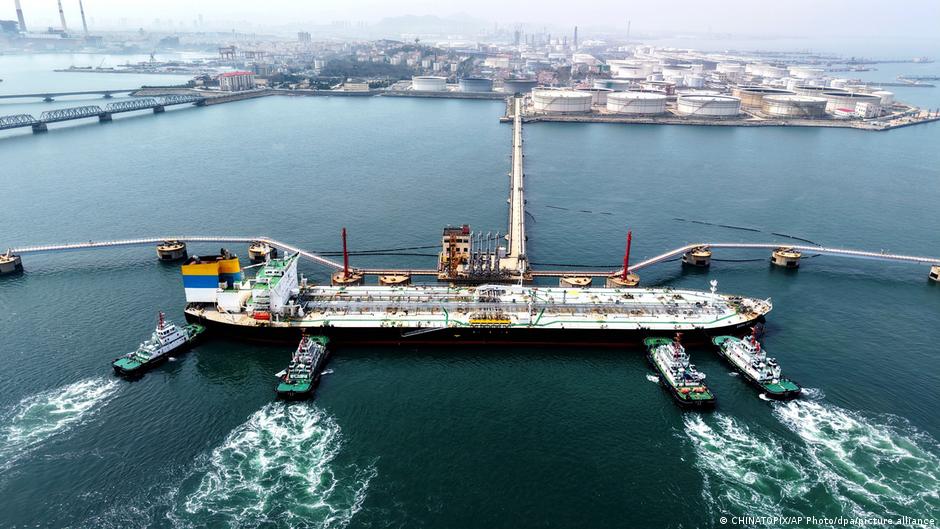
China pushed back on what it called "illegal unilateral sanctions" after the US announced new measures earlier this week to cut off all potential sources of revenue to Iran. US Treasury Secretary Scott Bessent on Monday described the sanctions package as an "economic D-Day" against Tehran, and warned any economic engagement with the regime would "expose those responsible to the full reach" of US power. China is Iran's top trade partner and provides a lifeline to Tehran mainly through oil purchases, but also with banking, technology and dual use goods, which can be used both for civilian and military purposes.
When asked about if Chinese banks would be included in the new measures, Bessent warned "no one was above the reach of US sanctions." But with US President Donald Trump due to meet his Chinese counterpart Xi Jinping in September, Washington will need to be careful with any moves affecting China-Iran trade ties. The initial US sanctions package stops short of targeting major Chinese banks. It instead focuses on 60 smaller entities, individuals, and vessels, both in mainland China and Hong Kong, that are part of the ecosystem supporting "illicit nuclear and missile technology procurement, cyber operations, and oil‑revenue generation networks." China purchases up to 90% of Iranian oil exports, some of it through independent "teapot" refineries which end up rebranding the oil or using intermediaries to bypass US sanctions.
In May, China's Commerce Ministry ordered domestic businesses and teapot refineries to ignore US restrictions targeting several of these refineries. At the time, Bessent said China's Iran oil purchases amounted to "funding the largest state sponsor of terrorism." To view this video please enable JavaScript, and consider upgrading to a web browser that supports HTML5 video On Tuesday, Chinese Foreign Ministry spokesperson Lin Jian said cooperation between China and Iran "has always been conducted within the framework of international law and should not be interfered with or disrupted." China maintains a transactional relationship while framing instability in the Middle East as a failure of US policy. At the same time, Beijing also projects the image of a stable, responsible superpower, and avoids being lumped together with rouge states the US accuses it of supporting.
Beijing also values its trade relationships with Saudi Arabia and the UAE, meaning it carefully balances its ties so as not to alienate Iran's regional rivals. The ongoing conflict in the Middle East and the US sanctions package is likely to be on the agenda when Iranian President Masoud Pezeshkian attends the Shanghai Cooperation Organization (SCO) summit in Kyrgyzstan, scheduled for August 31 to September 1. The SCO focuses on Eurasian security and is part of China's strategy of creating a "multipolar" world order to counter the global influence of the US.
China has been "trying to deepen its engagement and expand the scope of its relations with Gulf countries. From this perspective, Iran remains a useful and important partner for China, but it is not irreplaceable," William Yang, senior analyst for Northeast Asia at the International Crisis Group, told DW. "In some ways, China benefits from Washington's continued involvement in regional security and defense and is not seeking to replace the US in that regard," Yang added.
However, US military setbacks during the Iran war have called this security umbrella into question and have changed the strategic landscape in the Middle East, Gu Xuewu, political scientist and director of the Center for Global Studies at Germany's University of Bonn, told DW. "Against this backdrop, Beijing will not yield to US pressure to sever economic and trade ties with Iran or to help the US maintain its presence in the Middle East," Gu said. Since the Iran war was launched in late February, Beijing has consistently called for a diplomatic solution to the conflict.
Extract — continue reading at the source.