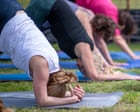
At 6am on the beach at Westgate-on-Sea in Kent, Angela Brier-Stephenson used to meet a small group of about 10 people for yoga. The class lasted 45 minutes and participants paid what they could. Thanet council told her she would need to pay £1,200 a year as part of its seasonal licensing scheme.
She has not run the class for the past two summers as a result. Councils across England and Wales require hundreds of pounds in fees, dozens of pages of paperwork and first-aid certification from people running small, free or donation-based exercise classes in parks and on beaches, according to a new report published by the Campaign for Freedom in Everyday Life. The report, titled Banned from the Beach: the Crackdown on Outdoor Community Sport, documents how licensing schemes first aimed at commercial personal trainers and bootcamps in the early 2000s now also apply to even small community gatherings, including a qigong class of seven people, and a mother-and-baby choir.
Josie Appleton, the director of the Campaign for Freedom in Everyday Life, said: “The fees bear no relation to any money these classes make and are frequently far larger than the cost of running the scheme.” Thanet brought the fee down to £300 for fitness activities before the 2026 season. When an individual or organisation provides a service to the public that involves payment or donation, regardless of pricing structure, it remains a commercial activity,” a council spokesperson said. Fees are set by business type and location and started at £300 for fitness activity in locations such as Westgate-on-Sea.” In Bristol, Julia Turner is resisting a £100 fee to run her £8-a-session, BYOB (bring your own baby) choir.
I would be happy to pay a one-off fee for the council to check my risk assessments but other than that, what are we actually paying for?” she said. Turner has staged a flash-mob singing demonstration inside City Hall. But she admitted that running the choir, which began as a passion project, was at risk of becoming “too difficult to bother with”.
Also in Bristol, Chloe Broomby said the fees had made it impossible to run her weekly, donation-based qigong classes on the Downs. But she too has stopped the sessions since fees were introduced. Bristol city council said its scheme included discounted rates of up to 75% for small businesses and charitable organisations.
The councils, she said, used a range of legal mechanisms, from events-licensing schemes designed for large events, and others designed for commercial personal trainers in the early 2000s, to Victorian park bylaws. In the London borough of Richmond, running an unlicensed exercise class is a criminal offence – enforced by a private contractor, Parkguard, which issues fixed-penalty notices. In the London borough of Waltham Forest, a free outdoor fitness class was stopped mid-session by two park rangers.
Extract — continue reading at the source.