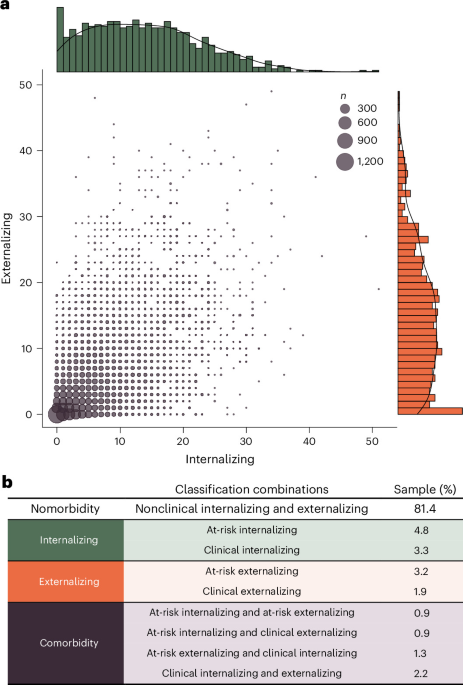
Emerging classification frameworks claim that covariation among psychopathology dimensions reflects comorbidity. We scrutinized this claim by applying Bayesian change point models to four waves of the Adolescent Brain Cognitive Development Study data (N = 11,868 youths; 48% female) and examined associations among higher-order psychopathology dimensions. Covariation between psychopathology dimensions was driven by nomorbidity, not comorbidity: we observed strong positive associations among psychopathology dimensions at relatively extreme low (asymptomatic) levels (for example, when three to five symptoms were endorsed) and weak positive associations at higher levels.
For instance, at wave 1, a 1-point increase in internalizing was associated with a 32% increase in externalizing at nearly asymptomatic levels (B = 0.28), compared with only a 7% increase at higher levels (B = 0.07). These findings challenge existing assumptions about comorbidity in nonclinical samples, suggesting that covariation is more accurately explained by the absence of symptomatology rather than shared psychiatric conditions. Psychiatric comorbidity, the co-occurrence of two or more mental disorders, is often regarded as the ‘rule rather than the exception’1,2.
But epidemiologic data suggest that it is statistically uncommon to be diagnosed with two or more conditions, let alone three or more, at the same time3. At a given time, most people in the general population do not exhibit appreciable levels of symptomatology to warrant a psychiatric diagnosis. Around 70% of the population exhibits what we term ‘nomorbidity’—wherein an individual is not diagnosed with a single mental disorder—when past-year diagnoses are assessed, and 50% when lifetime diagnoses are assessed3.
Further, when followed over long stretches of time, many people (~17–40%) are not diagnosed with a single mental disorder at any time4,5. Of course, conditional upon receipt of one diagnosis, comorbidity is far more common. If a person receives one diagnosis, their odds of receiving two diagnoses increases, and so on.
Modern classification systems, such as the Hierarchical Taxonomy of Psychopathology6, argue that this ‘rampant comorbidity problem’7,8 results from the fact that the Diagnostic and Statistical Manual of Mental Disorders and related systems ‘do not carve nature at its joints’9,10,11. According to this criticism, comorbidity is largely conceivably artefactual, arising because we draw arbitrary borders around phenomena that overlap phenotypically and etiologically6,12. In response, these systems harness the supposed overlap among putatively distinct conditions using covariance-based modeling and reorganize psychopathology into a more parsimonious set of dimensions.
Products of covariance-based models have, in turn, been widely promoted as capturing sources of psychiatric comorbidity13,14. Across nearly half of a century and thousands of studies, these efforts have converged upon two broad psychopathology dimensions: externalizing and internalizing6,15,16,17, which were first studied in youth15 nearly thirty or so years before they were studied in adults17. Externalizing encompasses conditions of poor behavioral and emotional control18 (for example, conduct disorder, oppositional defiant disorder and substance use disorder), whereas internalizing encompasses conditions that are characterized by intense negative emotions19 (for example, generalized anxiety disorder, major depressive disorder and specific phobia).
Extract — continue reading at the source.


