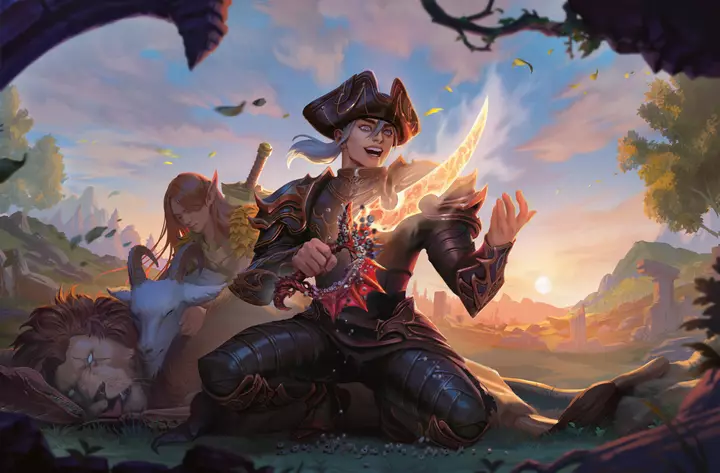
Picture Kellnor, a burly, Conan-looking Barbarian standing with a mighty weapon in each hand. In one, he holds a demonic sword stolen from the Cult of Asmodeus. In the other is Azuredge, a glowing battleaxe forged by the legendary archwizard Ahghairon.
This intelligent weapon is inhabited by the spirit of Lady Lauroun, a legendary hero of Waterdeep. It operates under rules remarkably similar to Thor’s Mjolnir: it becomes impossibly heavy to hold if the character trying to wield it isn’t worthy, and it can be thrown through the air before returning to its owner’s hand. Unfortunately for Kellnor, Azuredge demands that its wielder remain virtuous, so sharing a wielder with an evil sword was non-negotiable.
Even the numbers made Kellnor’s choice practically inevitable. And so, after extracting the Eye of Golorr hidden inside the sword’s hilt, Kellnor simply dropped it outside the entrance to the cult’s hideout and moved on. The rest of the do-gooders in the party wanted nothing to do with it.
This happened in a heavily modified version of Waterdeep: Dragon Heist that I ran for my Dungeons & Dragons group years ago. The adventure involves navigating several warring factions while trying to recover three Eyes of Golorr that unlock the key to a massive hoard of treasure hidden in the city. I placed one of the Eyes inside the sword myself, transforming it into an important piece of the campaign’s central mystery.
But by also introducing Azuredge, I brought that sword’s story to an abrupt end. What if Kellnor had kept it? Would the Cult of Asmodeus have hunted him for the rest of his life?
Might the sword have slowly corrupted him into joining the cult — perhaps even becoming its new leader? Those storytelling possibilities vanished once a more powerful weapon came along. It’s one of D&D’s most persistent problems: Characters become more powerful, but most of the objects accompanying them do not.
Extract — continue reading at the source.