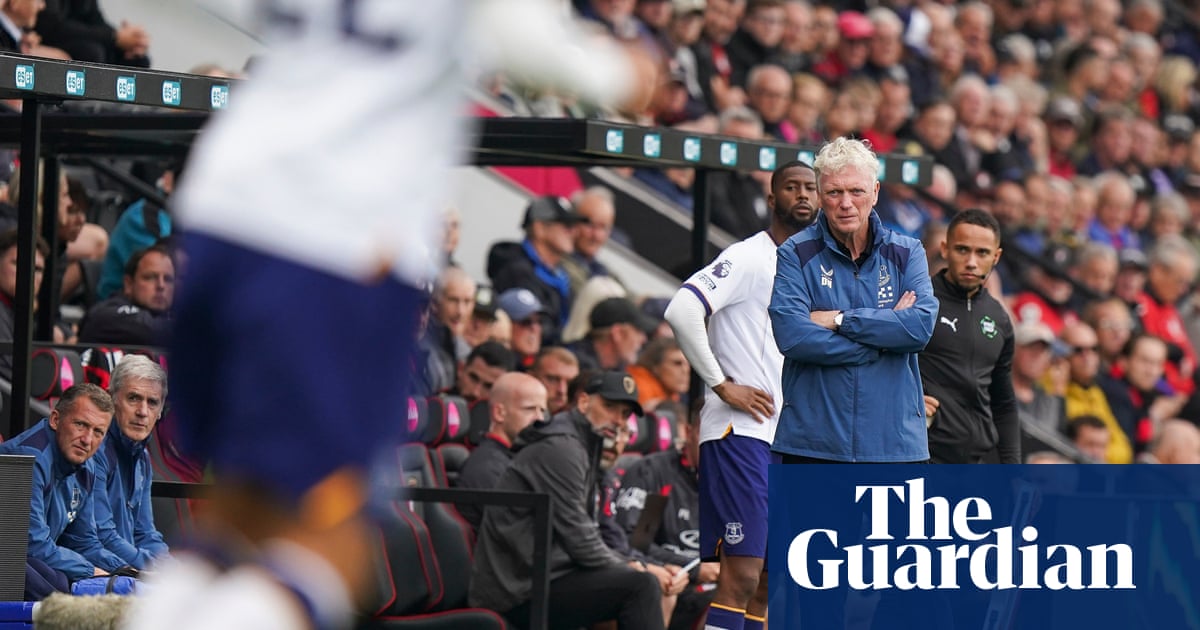
To be placed in the same bracket as owners whose lack of ambition, lack of resources and/or incompetence has contributed to the longest trophy drought in Everton’s history, particularly 20 months into a reign that has accompanied the move to a glittering new stadium and the clearing of onerous debt, should be cause for considerable discomfort and embarrassment at The Friedkin Group (TFG) on Wednesday. The slight on Everton’s owner is neither unkind nor unfair. At least Farhad Moshiri had a go before the taps were turned off.
TFG may have restored financial stability to Everton after the near-ruinous chaos of Moshiri’s final years and his attempts to sell to 777 Partners but its reputation as “winners” – as the club’s chief executive, Angus Kinnear, labelled his American employers – has been shredded in the space of four days. The description always appeared generous given its approach to the summer transfer window, part two of Everton’s strategic rebuild according to Kinnear. But from accepting Nottingham Forest’s £35m bid for Harrison Armstrong on Saturday morning to Folarin Balogun walking away from a £40m move from Monaco on Tuesday night, and more in between, TFG has positioned itself as just another Everton owner unable or unwilling to realise the club’s potential and to give an expectant fanbase grounds for optimism.
Evertonians hoped for an overdue departure when TFG acquired the club in December 2024 and proceeded to refinance damaging loans and the long-term repayment costs of Hill Dickinson Stadium. The shambles of deadline day, however, was all too familiar and has caused serious damage to its standing among supporters. David Moyes kept his counsel throughout pre-season as Everton spent £16.5m on Hayden Hackney, rising to £25m for last season’s Championship player of the year, £18m on each of Merlin Röhl and Tyrique George, who he had on loan last season, £7m on Christian Nørgaard and swapped Dwight McNeil for Brennan Johnson.
The most Everton paid up front for a player all summer would prove to be £18m. When Moyes did eventually speak in public it was to stress, repeatedly, the need for Everton to sign more players, more quality and to keep their best talents. At the end of last season he had 22 outfield players at his disposal.
At the start of deadline day he had 20 outfield players. By the end of transfer deadline day he had 18. That total includes one striker, Thierno Barry, no back-up for either full-back and, strictly speaking given that Ainsley Maitland-Niles did not start out in the position, no natural right-back.
Everton sold their most creative asset, Iliman Ndiaye, to Manchester City in a below-market price £65m deal despite the Senegal international having three years on his contract. They sold Beto, their only striking alternative to Barry, before securing a replacement and were left desperately scrambling around for one when Balogun’s medical went awry. Manchester United said no to a loan offer for Joshua Zirkzee that arrived a few hours before the deadline.
Extract — continue reading at the source.