/https://tf-cmsv2-smithsonianmag-media.s3.amazonaws.com/filer_public/f8/2a/f82aae37-3a31-4995-b8f3-4be66db320c8/members_of_the_research_team_during_the_documentation_and_analysis_work.jpeg)
Spain’s Cova de les Dones has surprised archaeologists time and again, revealing traces of human activity spanning thousands of years. In the 1960s, archaeologists identified Iron Age materials at the site, leading to its classification as an Iberian cave sanctuary. Five years ago, another team discovered that the cave contained Paleolithic art—some of it apparently more than 24,000 years old.
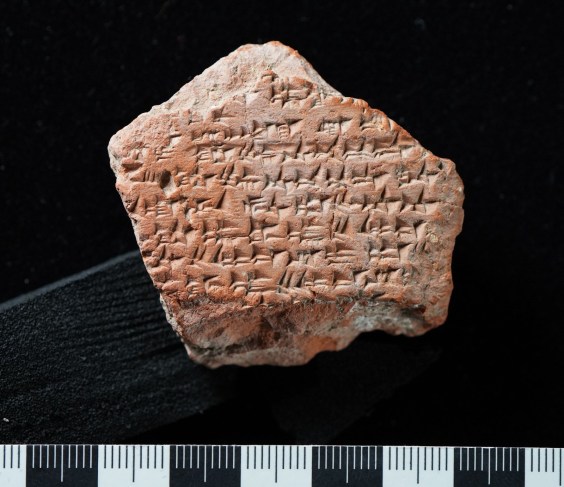
Last year, they announced that one of the cave’s chambers contained at least 15 Roman inscriptions and a first-century coin from the reign of Emperor Claudius. Now, following further investigation, researchers have identified the chamber as a Roman sanctuary where women appear to have taken an active role in the worship of a female deity some 2,000 years ago. The team has now documented at least 110 Latin inscriptions on the chamber's walls and ceilings—the largest known concentration of Latin inscriptions in a Roman cave sanctuary, according to the researchers.
Five of the inscriptions are votives, tributes dedicated to a goddess reverentially called Domina, or “the Lady,” says researcher Silvia Alfayé Villa, a historian at the University of Zaragoza, in a translated statement from the University of Alicante. Three of them also contain the term MALACI, which Alfayé Villa describes as a previously unknown designation for a goddess. Its precise meaning—and its possible connection to the cave’s abundant water—remains under investigation.
The experts identified several female names among the inscriptions, says researcher Virginia Barciela, an archaeologist at the University of Alicante, in the statement. They also discovered jewelry, chalice-shaped vessels, ceramic fragments, animal bones and spindle whorls on the surface of the chamber, which is located more than 650 feet from the cave entrance. The researchers’ new findings have provided clues about who used the cave and how they may have worshipped there.
Barciela says the spindle whorls, possibly offerings of textile-working tools, fit the inscriptional evidence for women’s active participation in the sanctuary. The fact that five of the inscriptions refer to the same deity, and that they are concentrated in a defined area far from the cave's entrance, suggests that the chamber was a space for an organized cult, says researcher Sergio García-Dils, an archaeologist at the National University of Distance Education in Seville, in the statement. Women took part in Roman religious life as worshippers, dedicants and, in some cults, priestesses.
Cova de les Dones lies near Millares, a small inland town in Valencia’s mountainous interior, about 40 miles southwest of the city of Valencia. Although its Iron Age artifacts had drawn researchers’ attention by the 20th century, the cave’s wall art wasn’t discovered until 2021. In 2023, a team led by Aitor Ruiz-Redondo, an archaeologist at the University of Zaragoza, recorded more than 110 graphic units, including paintings and drawings.
Extract — continue reading at the source.