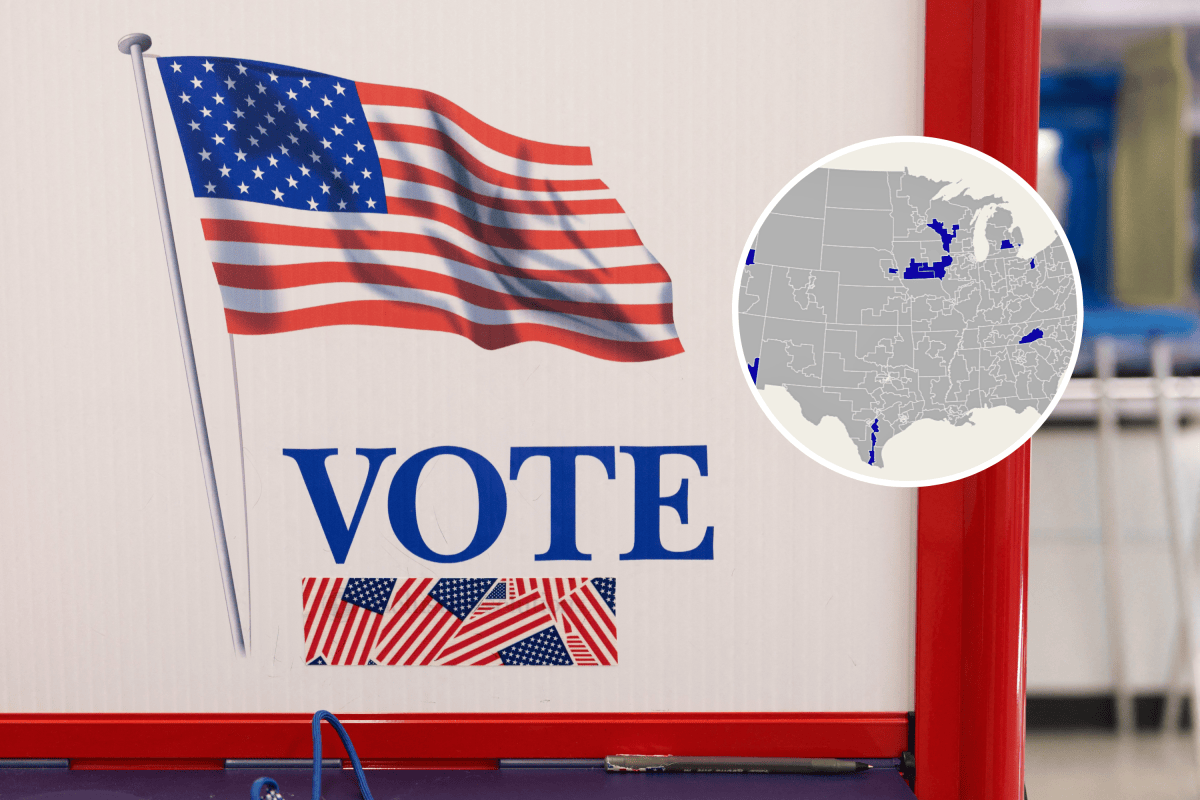
Political forecaster VoteHub projects Democratic victories in 15 House races across states where President Donald Trump won in 2024, potentially giving the party a route to a majority in the midterm elections on November 3. The contests will test whether dissatisfaction with the president can overcome Republican advantages built into parts of the congressional map. Voters from suburban Arizona to Pennsylvania’s industrial communities and the heavily Hispanic 15th District of Texas could help decide control of the House.
Zachary Donnini, VoteHub’s head of data science, told Newsweek in a phone call that Trump’s standing with voters was the clearest factor connecting the 15 races. VoteHub expects the movement to extend across the country, although not evenly. Donnini described the projected gains as “more of a reaction to the national environment.” Meanwhile, Kyle Kondik, managing editor at political forecaster Sabato’s Crystal Ball, based at the University of Virginia Center for Politics, told Newsweek in emailed comments that “this is going to be a much bluer year than 2024 was, perhaps a 10-point national swing to the left or so.” He added: “It's natural that many districts and states that voted for the president are now very much in play in a bluer environment.” Daniel Schatz, political scientist and former visiting scholar at Harvard, Stanford and Georgetown, said the significance lay partly in how widely Republicans may have to spread their resources.
Nicholas Stephanopoulos, Harvard Law School professor specializing in election law, noted that North Carolina, Ohio and Texas redrew districts to help Republicans, while Utah created a Democratic district and Arizona, Iowa and Pennsylvania used what he described as reasonably fair processes. If Democrats win the House popular vote by approximately 8 points, Stephanopoulos said, Republican gerrymandering would still create “a substantial pro-Republican skew,” but one that “just wouldn’t be big enough to maintain Republican control of the House.” The midterm elections forecast suggests Democrats can compete well beyond blue states, although analysts cautioned that the races reflect different local circumstances rather than a uniform political realignment. VoteHub gives Democrats an 84 percent chance of controlling the House, with its projection last updated on October 14.
Arizona’s 1st District: VoteHub favors Democrat Amish Shah over Republican Jay Feely in an affluent district centered around Scottsdale. Donnini said comparatively wealthy white communities represented the kind of territory where Republicans were performing “least bad,” making the contest a demanding test of suburban movement. Arizona’s 6th District: Democrat JoAnna Mendoza is projected to defeat Republican Juan Ciscomani.
The Tucson-area district also contains rural and heavily Hispanic communities, giving Democrats a different potential coalition from the one supporting Shah. Dave Spencer, host of the Practically Political podcast, told Newsweek via email that Arizona and Texas would help show whether some Hispanic voters who supported Trump in 2024 are moving back toward Democrats over immigration policy and living costs. Iowa’s 1st District: VoteHub places Democrat Christina Bohannan ahead of Republican Mariannette Miller-Meeks after Democrats came close in 2024.
Donnini included it among seven narrowly decided seats that represent the party’s “low-hanging fruit” in the battle for a majority. Iowa’s 3rd District: Democrat Sarah Trone Garriott is favored over Republican Zach Nunn. VoteHub sees Democrats gaining in agricultural and transportation-dependent regions exposed to higher fuel, trade and logistics costs, Donnini said.
Extract — continue reading at the source.