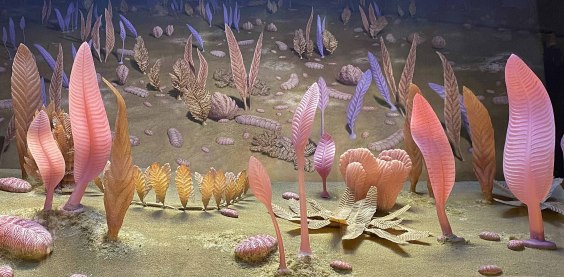
Because soft tissues like organs are very rarely preserved, paleontologists are left to piece together extinct life from the hard stuff (bones, shells, exoskeletons, etc.). Oddly, that wasn’t always true. During the late Ediacardian period (579 and 539 million years ago) the newly evolved complex organisms were mostly squishy.
And yet, they left plenty of fossils behind—sometimes entire alien-like ecosystems. Well, it’s been something of a mystery, but now a new study published in Current Biology may have finally cracked the case. Read more: “All the Microbes That Could Survive in Space” Before mineralized body parts like shells evolved in the Cambrian period, Ediacaran life held its structure using the next best thing: collagen.
Collagen, like plastic, is a pretty sturdy polymer. So could a gap between the evolution of collagen and the evolution of collagen-eating microbes explain the bounty of Ediacarn fossils? To find out, Vixseboxse and a team of paleobiologists traced the evolutionary history of collagenases using 700 bacterial genomes and compared them to a tree of life.
The enzymes, they discovered, actually predated animals. But the key wasn’t when they evolved, it was where they evolved. According to the team, collagenases first popped up in anaerobic microbes living in oxygen-free environments.
The strange-looking Ediacaran life-forms, on the other hand, lived in oxygenated oceans. After aerobic ocean microbes learned to eat collagen, Ediacaran fossils started to taper off in the fossil record. But they didn’t disappear completely.
Something similar may have happened with plants. Lignin, the sturdy polymer that makes up wood, evolved around 400-360 million years ago (understandably this proved to be a pretty big innovation for terrestrial plants). White rot fungi, on the other hand, didn’t evolve the ability to break down lignin until 290 million years ago, per a 2012 study of fungal genomes.
Extract — continue reading at the source.
/https://tf-cmsv2-smithsonianmag-media.s3.amazonaws.com/filer_public/0e/75/0e759221-7bae-4759-ae5c-ea84bbb4b9d5/screenshot_2026-10-09_at_33437pm.png)
/https://tf-cmsv2-smithsonianmag-media.s3.amazonaws.com/filer_public/a3/8d/a38dd753-9c7e-4e71-b9ee-883308dc5d69/highresscreenshot00111_webpage-image.png)

/https://tf-cmsv2-smithsonianmag-media.s3.amazonaws.com/filer_public/dd/6f/dd6f5dc1-1cfb-4de1-ac62-ea52fffeaaf4/gettyimages-2298735670.jpg)
