Objective neurometric markers that track depressive symptom severity across the continuum remain limited, particularly in untreated populations. Although electroencephalography offers promise, most prior studies are inconsistent, restricted to case–control discrimination or difficult to interpret mechanistically. These limitations raise the possibility that symptom-related information is not confined to focal electroencephalography features but instead distributed across cortical networks.
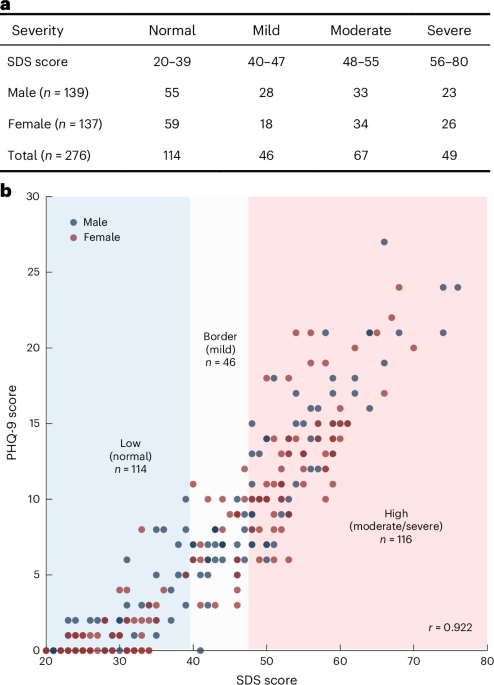
Here we show that self-reported depressive symptom severity is associated with large-scale phase-resetting dynamics and can be characterized by an integrated index derived from phase-resetting rate modulation (PRRM), a measure of source-locked, time-lagged modulation of phase-resetting rate from source to target electrodes. In a resting-state cross-sectional cohort of 276 untreated adults (139 males and 137 females; aged 18–59 years) spanning a broad symptom range, including 116 with moderate-to-severe symptoms, an integrated index aggregating multiple individually weak but collectively informative PRRM-based features in the upper-alpha and low-gamma bands showed cross-validated predictability of symptom scores (r > 0.6) and achieved approximately 80% accuracy in discriminating moderate-to-severe from low-symptom individuals. These findings provide evidence for a physiologically interpretable neurometric signature and suggest that the PRRM framework may support future objective assessment and longitudinal monitoring of depressive symptom severity in untreated populations, although independent validation in clinically characterized cohorts is needed before clinical application.
Major depressive disorder (MDD) is a leading cause of disability worldwide and imposes a substantial socioeconomic burden1. Early detection is essential for effective intervention, yet it remains challenging. Difficulties in recognizing depressive symptoms can hinder help-seeking, particularly among young people2.
Current symptom assessment still relies heavily on subjective reports and clinician-rated measures, which limits objective assessment during mild or subclinical stages and complicates scalable population-level monitoring. Consequently, there remains a critical need for objective neurometric markers capable of indexing depressive symptom severity across the symptomatic continuum. Scalp electroencephalography (EEG) provides a promising and accessible window into large-scale brain dynamics, offering practical advantages over more resource-intensive neuroimaging modalities for repeated and real-world deployment3.
Previous EEG studies have reported group-level differences between patients with depression and healthy controls in measures such as spectral power and hemispheric asymmetry4,5. However, these findings have shown considerable inconsistencies across studies, and no single feature has demonstrated robust reproducibility across large and independent datasets. More recently, deep-learning approaches have reported high accuracy in classifying patients with depression versus healthy controls6, but these models are typically trained on relatively small clinical cohorts, limiting their generalizability.
In addition, their limited interpretability constrains their utility for mechanistic understanding and clinical translation7,8. Importantly, most EEG studies of depression have focused on patients with moderate-to-severe, clinically confirmed MDD, leaving early-stage and subclinical symptomatology relatively underexplored. Such studies may primarily capture neural alterations associated with prolonged illness or treatment history rather than mechanisms more directly linked to core symptom expression.
Extract — continue reading at the source.


