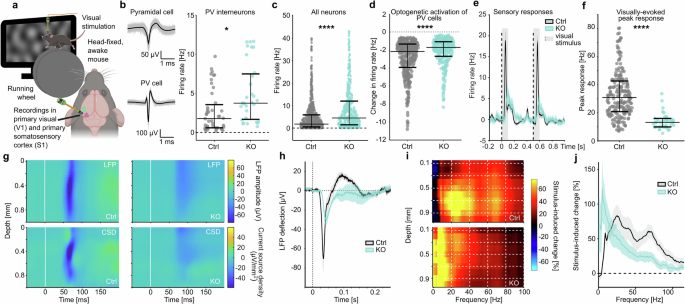
Parvalbuminergic (PV) interneurons are central to cortical network stability and psychiatric vulnerability. Here, we identify DNA methyltransferase 1 (DNMT1) as a key epigenetic regulator linking PV interneuron function to glial and extracellular matrix remodeling. Conditional PV-specific Dnmt1 deletion, combined with single-nucleus RNA-seq (snRNA-seq), snATAC-seq, in vivo electrophysiology, histology, and behavioral analyses, revealed that DNMT1 loss increases PV spiking but reduces inhibitory efficacy, driving network desynchronization and depression- and anxiety-like behavior in mice.
These physiological changes were accompanied by non-cell-autonomous transcriptional and chromatin alterations, affecting perineuronal net (PNN) organization and neuron-glia communication. Cell-cell communication analyses predicted reorganized perisomatic signaling, and compartmental modeling of oligodendrocyte lineage dynamics further revealed impaired formation of PNN-supporting perineuronal oligodendrocytes, consistent with a tissue-level reduction in PNN integrity. Together, our findings demonstrate that DNMT1 maintains inhibitory circuit stability through PV interneuron function, secondarily shaping glial states and extracellular scaffolds to support cortical network synchronization and affective behavior.
GABAergic interneurons are critical regulators of cortical circuit dynamics, ensuring precise control over pyramidal neuron activity and maintaining the excitation/inhibition (E/I) balance essential for healthy brain function. Disruption of inhibitory signaling contributes to maladaptive network states and has been implicated in a range of neuropsychiatric disorders, including schizophrenia and major depressive disorder (MDD)1,2,3. However, the etiology of such disorders is inherently multifactorial, due to interactions between genetic predispositions, environmental stressors, and epigenetic mechanisms that converge to shape disease vulnerability3.
The exact nature of GABAergic dysfunction in MDD therefore remains debated, with contradictory findings further complicating the establishment of a unified mechanistic framework4,5. Epigenetic modifications, such as DNA methylation mediated by DNA methyltransferases (DNMTs), form a crucial interface between external stimuli and neuronal function. Aberrant DNA methylation has been documented across multiple neuronal subtypes in psychiatric and neurological conditions, including schizophrenia, epilepsy, and MDD6,7.
Among DNMTs, DNMT1 has emerged as a key regulator of inhibitory circuit function8,9 and altered DNMT1 expression in cortical interneurons has been linked to schizophrenia and disrupted GABAergic signaling3. Within the diverse population of inhibitory neurons, parvalbumin-positive (PV) interneurons are especially important to regulate network activity. As fast-spiking interneurons, they synchronize network oscillations and gate excitatory inputs, thereby maintaining cortical E/I balance10.
Alterations in PV interneuron number or function have been causally linked to neuropsychiatric diseases11,12, and their vulnerability to chronic stress makes them prime candidates for involvement in stress-related mood disorder pathology13. Our previous work also demonstrated that DNMT1 exerts transcriptional control in postmitotic cortical interneurons9 and regulates synaptic transmission in PV interneurons by modulating endocytosis-dependent GABA reuptake at presynaptic terminals, thereby fine-tuning inhibitory output8. Beyond their intrinsic properties, PV interneurons are profoundly shaped by interactions with surrounding glial cells and the extracellular matrix.
Extract — continue reading at the source.


