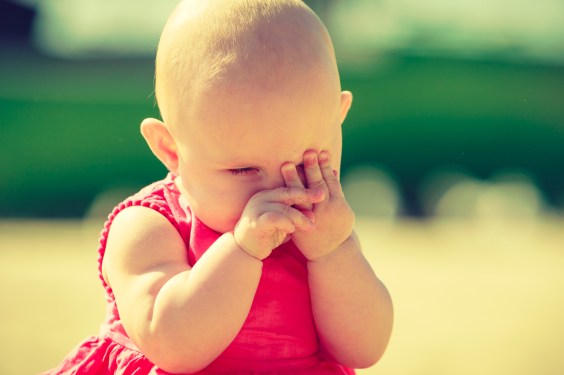
As recently as the 1980s, most physicians, philosophers, and neuroscientists believed that newborn babies were incapable of feeling pain. They were, in some sense, not considered fully human. This changed after a New England Journal of Medicine study published in 1987 found that infants undergoing surgery without anesthesia—then a routine practice—suffered massive, and potentially lethal, stress responses.
The more we look, the more it seems that babies develop many of the powers of adult minds much earlier than we thought. For example, in recent years, neuroscientists have begun to grapple with the possibility that babies not only can feel pain, but possess consciousness. Read more: “How Does Your Brain Know A Cat Is A Cat?” Now, some researchers have proposed that infants can experience complex emotions such as pride, shame, and guilt, which were thought to emerge much later, after the first few years of a child’s life.
In a review published in the Royal Society’s Philosophical Transactions B, European developmental psychologists Milica Nikolic and Robert Hepach report that evidence from developmental science suggests these emotions can be seen in the body language of babies—from birth to two years of age—via tiny micro-movements. These so-called self-conscious emotions could be useful to babies for both communication and motivation purposes, they write. I spoke with Nikolic about the nature of self-conscious emotions, how the findings square with neuroscientist and psychologist Lisa Feldman Barrett’s theory of constructed emotion, what culture might have to do with it, and why emotions so often seem to lead us astray.
You make a distinction in your study between standard emotions and self-conscious emotions. What are self-conscious emotions? When we talk about self-conscious emotions, usually we talk about emotions that are related to the self, where we think about ourselves as objects of other peoples’ attention, when we become acutely self-aware.
Emotions such as embarrassment, shyness, guilt, shame, pride, are all self-conscious emotions—some positive, some negative. You mention in the paper that these self-conscious emotions are visible not just in facial movements, like standard emotions, but also in posture, gaze, head direction. Why do they differ from standard emotions in terms of their physical expression?
Basic emotion theory proposes that there are emotions that are more universal and shared with other non-human animals, and then there are these more complex social emotions that evolved later, that are probably uniquely human. They also require certain more-complex socio-cognitive skills, such as understanding that we can be observed by other people, and for some more complex ones like shame, internalizing social norms and rules, understanding when we do something good or bad, understanding that when we harm someone, another person can suffer. All these skills are a bit more complex, so it’s thought that they are also expressed differently in the body.
Extract — continue reading at the source.



/https://tf-cmsv2-smithsonianmag-media.s3.amazonaws.com/filer_public/ad/5b/ad5bded0-e227-439b-b8a2-bfcb739fcd04/nobel-phys-med.jpg)
/https://tf-cmsv2-smithsonianmag-media.s3.amazonaws.com/filer_public/cf/d9/cfd99925-70cd-4305-bd45-87ba7e390e45/power_of_fashion_in_the_roman_empire_63_the_glyptotek__2026_ana_cecilia_gonzalez.jpg)