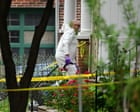
A dilapidated house, burned out above the second story, may hold clues to dark tales and – potentially – the darkest of endings as the FBI and police in Philadelphia try to unpick what took place at 417 West Chew Avenue for more than three decades. Last week, homicide investigators shifted their focus from examining an archive of a million photographs and film recovered from what is known locally as the “house of horrors” to excavating what is in or under the home of Raymond “RC” Horsch, a career criminal, local artist, author and snuff photographer who died last year aged 82, and his son Eugene, 44. So far, at least seven missing women have been linked to the home in the Olney section of the city, originally a German American neighborhood but now largely African American, Hispanic and Asian.
Investigators believe five are dead. Fifty-eight women seen on film and in photographs recovered from the trash-strewn property have been identified. Of those, 25 have been located but not yet interviewed; 19 have spoken with detectives but declined to cooperate.
Investigators are faced with a difficult task: how to discern from images whether Horsch’s subjects are posing, and what is real and what is staged. Such is the grim nature of snuff photography and the murky exchanges that lie beneath. Investigators have said that the five women appear unconscious, lifeless or injured, but with no bodies the medical examiner cannot issue death certificates.
It’s a tough investigation because the guy who had the house was a violent pornographer. Is it art or is it reality?” Deputy police commissioner Frank Vanore said at a news conference on 10 September: “Some of this is play-acting. Some of it we believe could be real, but we’re not there yet.” The five women who police believed to be dead are Blair Tonzelli, 35, missing since 2023; Nicole Fusaro and Maribel Fresses, both 27, who disappeared in 2018; Amy McHale, who disappeared in June 2016 and had been married to Horsch; and Gabrielle Amarando, 22, who disappeared in 2012.
Four miles from the Olney home lies Philadelphia’s Kensington neighborhood, an area notorious for its open-air drug use, prostitution and homelessness, and as a place where people simply disappear from life. Many women in the community last week recalled some of those identified by investigators. One had connections to the Olney house – her driver’s license was registered there – but declined to discuss the case.
Others said they recalled Horsch’s son, Eugene, currently in custody pending federal gun and drug charges, cruising the block in a black BMW. One remembered Fresses as an “Italian princess – sweet and kind”. Ashley, making her way from a woman’s shelter with a plastic bag of candies, syringes, and a glass bowl for smoking fentanyl or meth, said bleakly: “A lot of girls go missing here.
Extract — continue reading at the source.