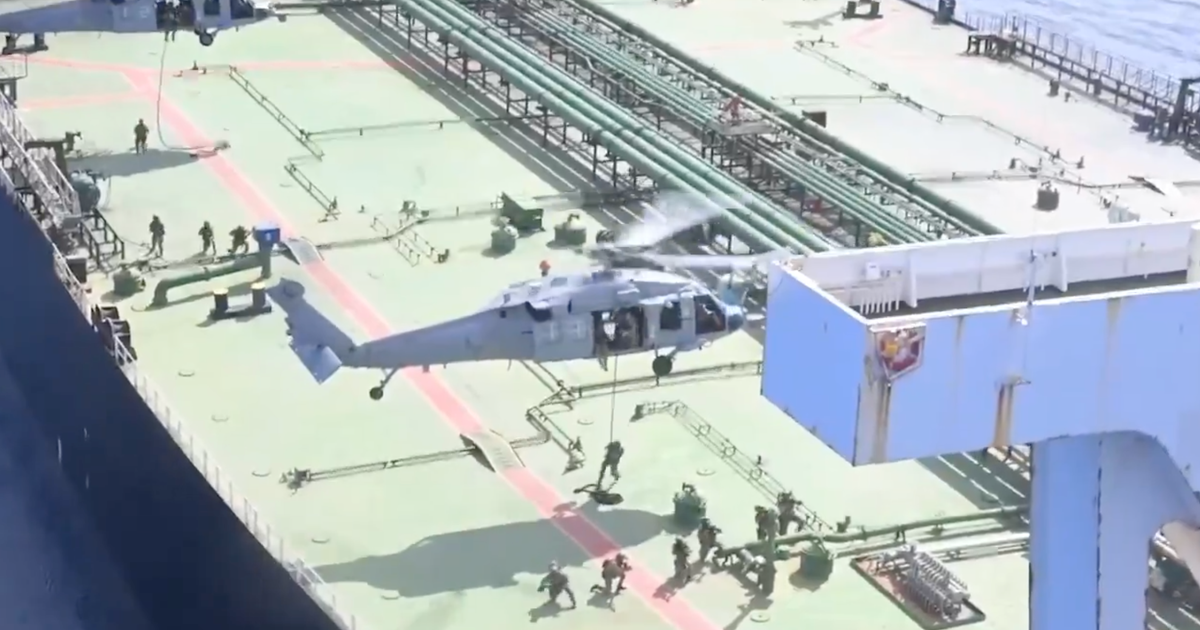
The Justice Department is attempting to revive a centuries-old law to speed up efforts to claim Iranian oil tankers seized during the war with Iran, but maritime law experts say the plan could face hurdles. The top federal prosecutor in southern Texas confirmed last month that his office is involved in the effort to revive the use of prize law, a specialized legal regime that has not been used regularly since the Spanish-American War. Now, the department plans to utilize the laws in arguments about whether ships and tankers captured at sea since the start of the Trump administration were taken legally.
"Our national security interests may require the United States military to seize vessels or cargo supporting the enemy during military conflict," Aaron Reitz, the U.S. attorney in the Southern District of Texas, said in a statement. "If that happens, our federal courts must be ready to adjudicate the disposition of these captured vessels and cargo." "Prize law is an ancient body of maritime law — already codified in statute but which we are now reviving — that sets the rules for how seized maritime property is condemned, returned, or disposed of," Reitz continued. The formal use of prize law, which first began in the early 17th century, would allow the administration to end-run civil asset forfeiture laws — which can often be bogged down in court — in favor of a streamlined process to force the handover of captured Iran-linked ships to the U.S.
A judge overseeing the boat capture would have to rule that the U.S. met a specific standard to be awarded the ship's prize. Under current law, U.S. district courts have jurisdiction over prize law cases once vessels are seized by the military. The Justice Department and Pentagon would have to establish that a seized boat is carrying contraband goods, transporting enemy soldiers, operating under enemy control, using fake documents or attempting to circumvent a blockade.
If the department's efforts survive legal challenges, the court could award the U.S. the prize of oil or other cargo aboard seized Iran-linked ships. The prize could then be sold, and funds would likely be transferred to the Treasury Department. The plan to revive prize law was first reported by Bloomberg Law.
It is the third time that the Trump administration has attempted to use a dormant or defunct mechanism to attempt to expedite the administration's priorities. In July, the Justice Department attempted to use the Alien Terrorist Removal Court, created in 1996 and which had never been used before, to speed up deportations of suspected "alien terrorists." Last year, the Trump administration deported Venezuelan migrants accused of belonging to the gang Tren de Aragua under the Alien Enemies Act of 1798, which had not been invoked since World War II. But international and maritime law experts say the administration's potential application of the centuries-old laws could backfire in the short term and the long term.
Michael Sturley, a maritime law professor at the University of Texas School of Law, said that 1789 federal law gives district courts and judges in the U.S. jurisdiction over potential prize law cases, but the seized vessel would have to be physically moved to the district — in this case, potentially the port of Houston. "You know, you go back to the Revolutionary War and the War of 1812, prize courts were huge," Sturley said. "Back when we didn't have much of a navy, we sort of outsourced a lot of the functions that you would expect a navy to serve, and would issue letters of embark to private individuals, authorizing them to go out and harass enemy shipping.
Extract — continue reading at the source.