Driver drowsiness detectors must be judged on minority-class sensitivity, calibration and alarm behaviour, not accuracy alone. DrowsyFormer-Gen combines physiological, vehicle and behavioural transformer streams with cross-modal fusion, an adaptive classification head and class-conditional diffusion augmentation. We re-implemented and evaluated it on shared causal windows and subject-disjoint folds against five classical baselines, using DMPS (225,000 samples; 15 drivers) and SC-DD (87,430 segments; 20 participants); DMPS drivers are a subset of SC-DD participants.
Baselines received nested hyperparameter optimisation; thresholds were fixed on training data. Tuned logistic regression reached 99.747 ± 0.031% accuracy, 0.953 drowsy-class recall and expected calibration error 0.0008, ahead of every neural configuration. Each proposed component failed a controlled test: removing diffusion augmentation improved every metric, and class weighting alone reached 0.989 recall; zeroing the adaptive head’s reference halved calibration error while its refresh interval was inert; and the fusion ablation, over 25 runs, ranged from 0.000 to 1.000 recall at a fixed threshold despite stable ranking.
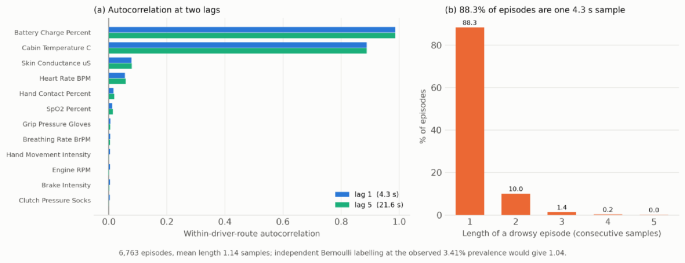
A single sample reached 0.915 recall against 0.956 for the 32-sample window. We report a negative result, conditional on the supplied records being what the source publications describe. The statistics of 461,312 road accidents and 168,491 fatalities in 20221 are not estimates of fatigue-related accidents.
Driver fatigue is a concern for road safety and the monitoring of driver behaviour and state, using both behavioural and physiological measurements, can identify changes in driver state2. A useful evaluation should separate overall classification accuracy from sensitivity to rare positive events, the reliability of predicted probabilities and the timing of alarms. It is possible to have high accuracy on an imbalanced dataset and miss positive events.
Similarly, a high alarm rate over an extended period doesn’t necessarily mean that the alarms are helpful in advance warning. We have previously developed a Driver Monitoring and Passenger System (DMPS) combining wearable and vehicle measurements3 as well as deep facial landmark detection (VigilEye)4 and the use of adaptive thresholding on skin-conductance signals (Deep-ATM DL-LSTM)5 for driving behaviour modeling (DrivNet)6. These systems vary with respect to the way they sense, the definition of a label, and the methods used for evaluating the label.
The published performance serves as context, but cannot be used to make a controlled comparison with the present experiments. DrowsyFormer-Gen is a model consisting of three domain-specific transformer encoders, sequential fusion and an adaptive classification head. A class-conditional denoising diffusion probabilistic model (DDPM) provides additional windows of the minority class in training.
Extract — continue reading at the source.


