The thalamus integrates sensory, motor and associative functions through distinct nuclei, yet the developmental principles driving their specification remain unclear. Here we generate a spatiotemporal single-cell multiomic and spatial transcriptomic atlas of the embryonic mouse thalamus, combined with barcoding-based lineage tracing. We identify two major glutamatergic lineages, sensory-related and motor-associative, each governed by different gene regulatory programs and temporal dynamics.
These lineages arise from spatially and molecularly distinct progenitor domains, revealing an early segregation of functional identities. Within the sensory lineage, we resolve branching sensory trajectories leading to first-order visual and somatosensory neurons, both emerging from a shared higher-order-like state. Using in silico predictions and in vivo perturbation, we identify Sp9 as a key regulator of visual thalamic fate.
Together, our findings define the molecular architecture and developmental trajectories that underpin thalamic modality specification, providing a framework to understand how functional circuits emerge in the mammalian brain. The thalamus serves as a central hub for sensory, motor and associative integration, comprising anatomically and functionally distinct nuclei that mediate both peripheral inputs and reciprocal communication with the cortex1,2. These nuclei are broadly classified as motor-associative or sensory.
Motor nuclei (for example, VA, VL, VM) and associative nuclei (for example, CM, MD) contribute to motor planning and executive function. Sensory nuclei are further categorized into first-order (FO) sensory nuclei (for example, dorsal lateral geniculate (dLG), ventral posteromedial (VPM), MGv), which relay peripheral signals to primary cortical areas, and higher-order (HO) sensory nuclei (for example, LP, Po, MGd), which participate in cortico-thalamo-cortical loops that support integrative sensory processing3,4,5,6,7. Each nucleus is characterized by distinct anatomical projections, electrophysiological properties and gene expression profiles8,9,10.
Thalamic excitatory neurons originate from progenitor cells located in the caudal thalamic neuroepithelium during embryogenesis11,12. Prior studies have defined broad neurogenic timelines13,14, reconstructed developmental trajectories14,15,16,17 and revealed progressive fate restriction18 together with preferential clonal relationships19 across developing thalamic lineages. However, the molecular and temporal mechanisms that direct the specification of divergent thalamic lineages and their functional modalities remain largely unresolved.
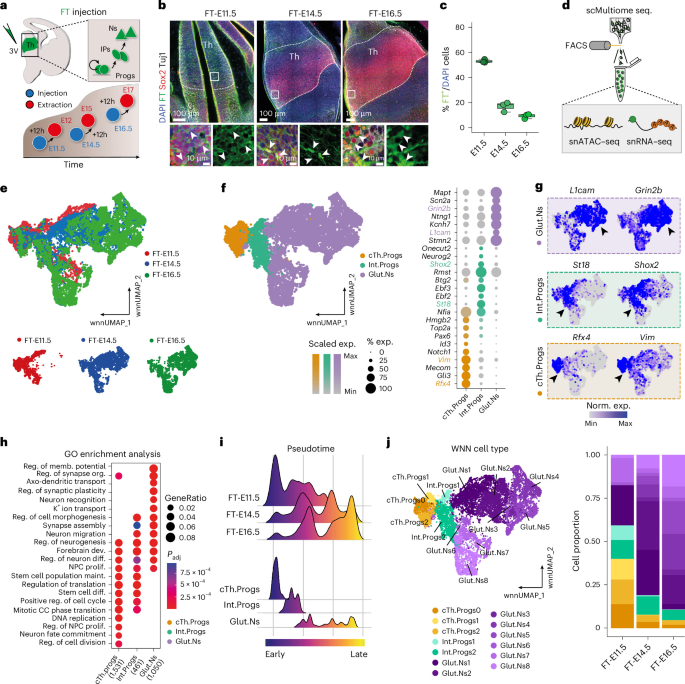
Here we generated a comprehensive spatiotemporal single-cell multiomic atlas of glutamatergic thalamic development across embryonic stages, complemented by spatial transcriptomics and temporally restricted lineage-tracing approaches that capture developmental cohorts across key windows of lineage commitment. We identified two principal glutamatergic lineages with distinct temporal dynamics that give rise to sensory-related and motor-associative thalamic classes. Within the sensory lineage, we further identify two divergent developmental trajectories leading to FO visual (dLG) and somatosensory (VPM) nuclei, both arising from a shared HO-like molecular state.
Extract — continue reading at the source.