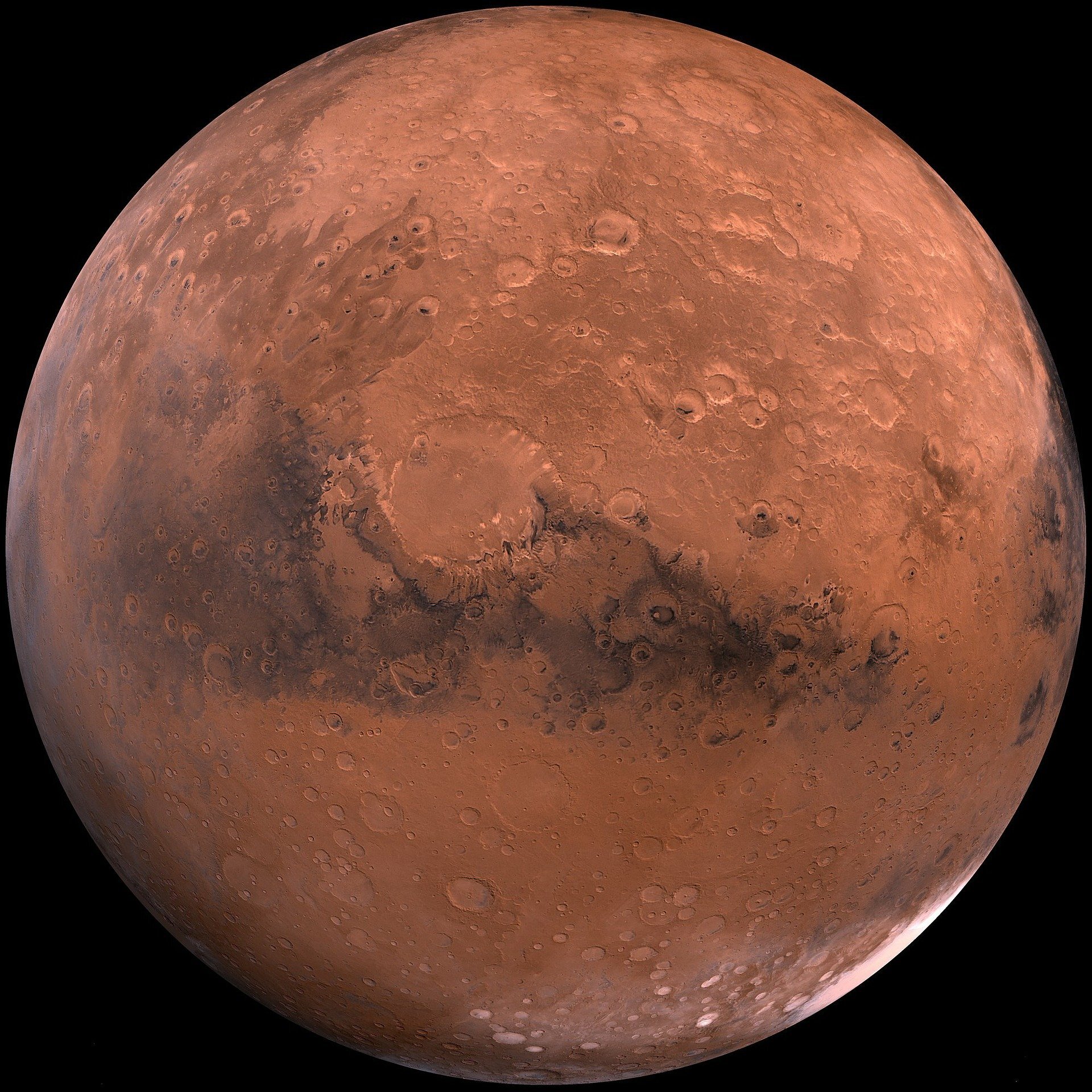
This article has been reviewed according to Science X's editorial process and policies. Editors have highlighted the following attributes while ensuring the content's credibility: Four and a half billion years ago, Earth and Mars were born in the rotating cloud of gas and dust that would eventually become our solar system. Yet exactly how the planets formed remains one of the most disputed questions in planetary science.
Now, researchers at the University of Copenhagen are adding new evidence to the debate. Using a novel approach, they have reconstructed the earliest stages of the planets' formation by analyzing their chemical composition. "The most surprising result was that Earth and Mars appear to have formed in different ways.
You might have expected that two planets formed side by side in the same solar system would share a more similar formation history," says professor Anders Johansen, who studies planet formation at the Globe Institute, University of Copenhagen. He co-led the new study with assistant professor Haiyang Wang. The paper is published in the journal Nature Astronomy.
Today, researchers broadly agree that planets are formed primarily in one of two ways or through a hybrid of both processes: Planets either emerge when giant space rocks, known as planetesimals, collide or when these large rocks accumulate smaller particles, a process known as pebble accretion. Planetary scientists have not settled on which of the two processes, or a combination of them, would best explain how rocky planets such as Earth and Mars formed. The researchers behind the new study believe that their findings support the so-called hybrid model.
However, the study goes a step further and offers a more explicit explanation of how Earth and Mars formed 4.5 billion years ago. "At least 75% of Earth's mass appears to originate from two young planets, known as protoplanets, that grew large by accreting pebbles, while planetesimals contributed up to 25%. In contrast, roughly three-quarters of Mars' mass appears to come from planetesimals, with the remaining quarter originating from pebble accretion," says Wang.
To understand how planets formed billions of years ago, scientists must rely on traces that still exist today. In the new study, the researchers closely examined specific elements in the outer layers of the planets: the crust and mantle. They focused particularly on so-called volatile elements, such as sodium, zinc and potassium, which evaporate relatively easily at high temperatures.
Extract — continue reading at the source.


