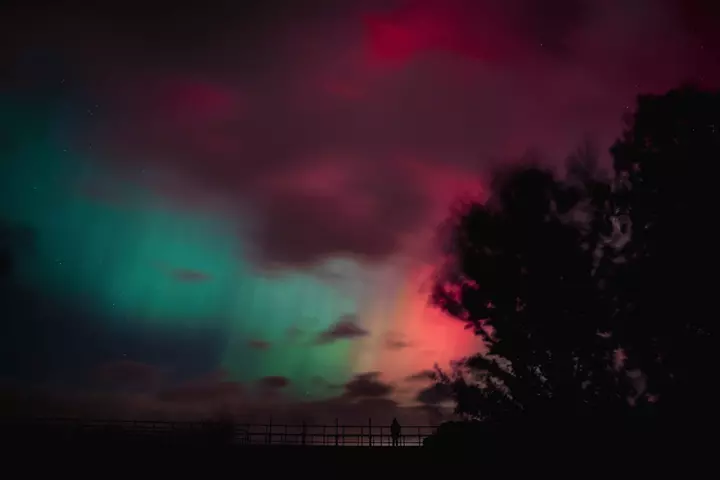
Satellites around Earth could face a previously underestimated radiation risk after scientists discovered that high-energy electrons had breached a boundary once thought to be "impenetrable.” A powerful solar storm broke through a space radiation boundary around Earth that scientists had thought the most energetic electrons could not cross. It caused potentially damaging electrons to travel at almost the speed of light in an area where scientists had rarely seen them before. The discovery came after a severe geomagnetic storm hit Earth in May 2024, producing auroras much further from the poles than usual.
During and after the storm, the Japan Aerospace Exploration Agency’s Arase spacecraft detected large numbers of extremely energetic electrons inside the boundary, closer to Earth, according to research led by Nagoya University. Earth's magnetic field traps high-energy particles in two doughnut-shaped areas called the Van Allen radiation belts. The outer belt mainly contains high-energy electrons, while the inner belt contains mostly high-energy protons.
In 2014, scientists identified a sharp boundary at the inner edge of the outer radiation belt, about three Earth radii from the center of the planet. One Earth radius is the distance from the center of Earth to its surface, about 6,371 kilometers. That means three Earth radii is just over 19,100 kilometers.
Because the most energetic electrons rarely cross this boundary, scientists have described it as an "impenetrable wall." Scientists still don't fully understand what creates this boundary. One possible explanation involves low-frequency radio waves called plasmaspheric hiss. These waves can push energetic electrons out of the radiation belts and into Earth's atmosphere.
During the May 2024 storm, Arase detected a large increase in electrons traveling close to the speed of light inside the supposedly protected area. Some were powerful enough to pass through some types of satellite shielding. Scientists wanted to know how these electrons had got inside the barrier.
One possibility was that they had been pushed inward from the outer radiation belt. Another was that electrons already inside the area had somehow been given much more energy. "One of the key questions was how these highly energetic electrons appeared inside the barrier," lead author Yoshizumi Miyoshi, a professor at Nagoya University’s Institute for Space-Earth Environmental Research, said in a statement.
Extract — continue reading at the source.