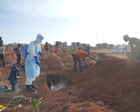
The Ebola outbreak in the Democratic Republic of the Congo is now the deadliest in the country’s history, with at least 2,325 people dead, according to government data, surpassing the toll from the 2018-20 outbreak. The DRC’s public health institute said confirmed cases had risen to 4,945, including 101 detected in the previous 24 hours. The World Health Organization has said the outbreak is on track to surpass west Africa’s 2014-16 Ebola outbreak as the biggest in history.
The 2014-16 outbreak resulted in 28,616 cases and 11,325 deaths across Guinea, Liberia and Sierra Leone, according to WHO data. On Friday, the UN said Ebola “is winning in the Democratic Republic of the Congo” and said the epidemic was killing one person every 30 minutes. Six of DRC’s 26 provinces have been affected, mainly those along the country’s north-eastern border.
More than 3,400 of the cases have been recorded in Ituri province, where the outbreak was first reported. The latest numbers of confirmed cases of Ebola in the DRC have made this outbreak – the 17th in the country’s history – the fastest-growing in the known history of the virus. It took almost five months for the 2014-16 west Africa outbreak to reach 1,000 deaths, compared with more than 2,000 deaths in less than three months in this outbreak.
There are no approved vaccines or treatments yet for the rare Bundibugyo strain of the virus that is responsible for the current surge in cases. Nonetheless, 1,000 people in the DRC have recovered from the infection, with 730 still in healthcare or isolation facilities. Clinical trials of two possible treatments for the strain began last month in Ituri.
Tedros Adhanom Ghebreyesus, the WHO director general, said last week that two vaccines developed specifically for Bundibugyo were now being tested on people. Thomas Parisch, a public health specialist recently deployed to the DRC with Médecins Sans Frontières, said: “Normally, as an outbreak progresses, the case fatality ratio should fall as contact tracing improves and patients are identified and treated earlier. Instead, we’re still seeing many cases detected very late, when treatment is less likely to succeed, with many identified only after they die in the community.” Uganda has reported at least 20 cases, all in the capital, Kampala.
The last case reported there was on 21 June and no community transmission has been recorded. The government declared the country Ebola-free on 28 July after the last Ebola patient, a Congolese national, was discharged on 16 July. In May, the WHO declared the outbreak in the DRC and Uganda as a public health emergency of international concern.
Extract — continue reading at the source.