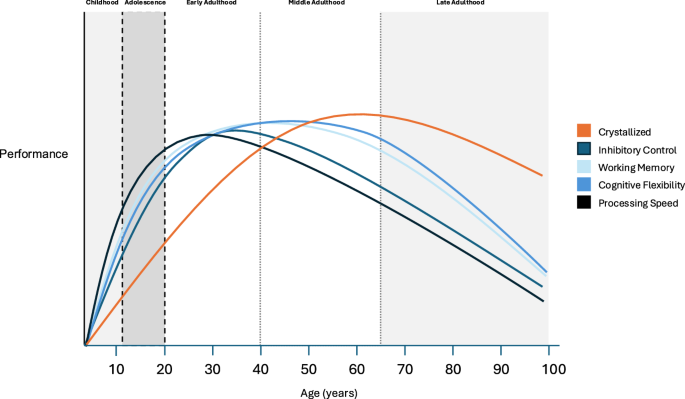
Brain-based predictive models offer a promising approach to understanding individual differences in cognitive functioning across the lifespan. This review synthesizes current literature on brain-based cognitive predictions using large-scale datasets, examining how methodological choices and data-related factors impact model performance. We find that brain-based predictive models demonstrate relatively consistent, albeit wide ranging performance across the lifespan, explaining approximately 10-40% of variance in cognitive abilities.
Key findings include: (1) models perform better when predicting general cognitive ability compared to specific functions; (2) crystallized abilities are more predictable than fluid abilities; (3) task-based functional connectivity generally outperforms resting-state approaches in younger populations, while structural measures become superior predictors in older adults; (4) multimodal approaches using hierarchical stacked models optimize prediction accuracy; and (5) elastic net and ridge regression provide optimal balance between predictive performance and computational efficiency. In summary, we propose methodological advances to improve the precision and utility of brain-based cognitive predictions. Cognition encapsulates a diverse range of hierarchical and interconnected functions that enable the acquisition, storage, retrieval, processing, and ability to act on information from the environment1,2.
Basic functions, such as attention, concentration, and information processing, lay the foundation for more advanced processes, such as memory and executive functions3. Cognition is crucial in the field of neuroscience because it represents the functional output of the nervous system4,5. As such, cognitive functioning or impairment can act as a key indicator of brain and transdiagnostic psychological health6.
Across the lifespan, such performance has direct implications for whether individuals function above or below thresholds critical to daily life. Establishing the neural substrates supporting these functions is therefore essential for identifying mechanisms underlying cognitive impairment. Traditionally, univariate approaches have been used to establish brain-cognition relationships, adopting group-level analyses and statistical inference testing across many brain-derived metrics.
More recently, with the increase in large-scale publicly available datasets with neuroimaging and cognition data, alongside advances in computational power, multivariate machine learning approaches have become increasingly viable for uncovering complex brain-cognition relationships. Common brain-derived metrics used for these predictions include structural measures (e.g., grey matter volume, cortical thickness, and surface area) and functional measures (e.g., resting-state or task-based functional connectivity). Brain-based predictive models can be used to quantify brain-cognition relationships in existing data and subsequently predict the dependent variables (i.e., cognition) in novel samples (i.e., individuals) using their individual-level independent data (i.e., neurobiology).
The application of brain-based predictive models to predict cognition is a recognized approach. For a comprehensive review of this methodology and best practices, see Sui et al.7 and for an in-depth discussion of different types of machine learning algorithms often used in cognitive neuroscience research, see Dhamala et al.8 and Greene and Constable9. Importantly, the actual predictive capacity of these models and the upper limit of their potential remain unclear.
Extract — continue reading at the source.


