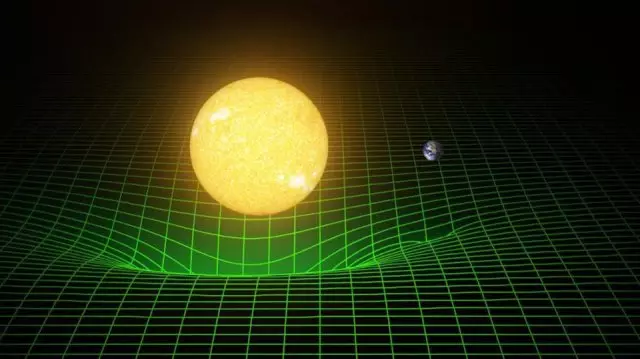
Although Albert Einstein is a legendary figure in science for a large number of reasons — including E = mc², the photoelectric effect, and the notion that the speed of light is a constant for everyone — his most enduring discovery is also the least understood: his theory of gravitation, general relativity. Before Einstein, we thought of gravitation in Newtonian terms: that everything in the Universe that has a mass instantaneously attracts every other mass, dependent on the value of their masses, the gravitational constant, and the square of the distance between them. But Einstein’s conception was entirely different, based on the idea that space and time were unified into a fabric, spacetime, and that the curvature of spacetime told not only matter but also energy how to move within it.
This fundamental idea — that matter and energy tells spacetime how to curve, and that curved spacetime, in turn, tells matter and energy how to move — represented a revolutionary new view of how gravitation worked. Put forth in 1915 by Einstein and validated four years later during a total solar eclipse — when the bending of starlight coming from light sources behind the sun agreed with Einstein’s predictions and not Newton’s — general relativity has passed every observational and experimental test we have ever concocted and thrown at it. Yet despite its success over more than 100 years, almost no one understands what the one equation that governs general relativity is actually about.
Here, in plain English, is what it truly means. Einstein’s original equation relates spacetime curvature to the stress-energy of a system (top). A cosmological constant term can be added (middle), or equivalently, it can be formulated as dark energy (bottom), another form of energy density contributing to the stress-energy tensor.
This equation looks pretty simple, in that there are only a few symbols present. But that apparent simplicity fades away as soon as you start asking what those symbols actually mean. Let’s focus on the second version in the figure above: the ones that reads G μν + Λg μν = 8πGT μν.
These five terms, all related to one another through what we call the Einstein field equations, are enough to relate the geometry of spacetime to all the matter and energy within it: the hallmark of general relativity. A mural of the Einstein field equations, with an illustration of light bending around the eclipsed Sun: the key observations that first validated general relativity four years after it was first theoretically put forth: back in 1919. The Einstein tensor is shown decomposed, at left, into the Ricci tensor and Ricci scalar, with the cosmological constant term added in after that.
If that constant weren’t included, an expanding (or collapsing) Universe would have been an inevitable consequence. You might be wondering what is with all those subscripts — those weird “μν” combinations of Greek letters you see at the bottom of the Einstein tensor, the metric, and the stress-energy tensor. Most often, when we write down an equation, we are writing down a scalar equation, that is, an equation that only represents a single equality, where the sum of everything on the left-hand side equals everything on the right.
Extract — continue reading at the source.