Physicists at the University of Oxford have helped demonstrate that one of quantum physics' strangest phenomena, quantum entanglement, can persist even among some of the heaviest and shortest-lived particles ever produced. The finding, made with CERN's powerful Large Hadron Collider, has been published in Physical Review Letters. Quantum entanglement occurs when two particles share properties in such a way that measurements of one can reveal information about the other, even when the particles are separated.
The connection is one of the most counterintuitive features of quantum mechanics and has challenged physicists' understanding of reality for decades. Albert Einstein famously called entanglement "spooky action at a distance," and scientists have previously observed the effect in systems involving photons, electrons and trapped ions. Entanglement has also become central to several emerging technologies, including quantum computers, ultra-secure quantum communication networks and advanced sensors.
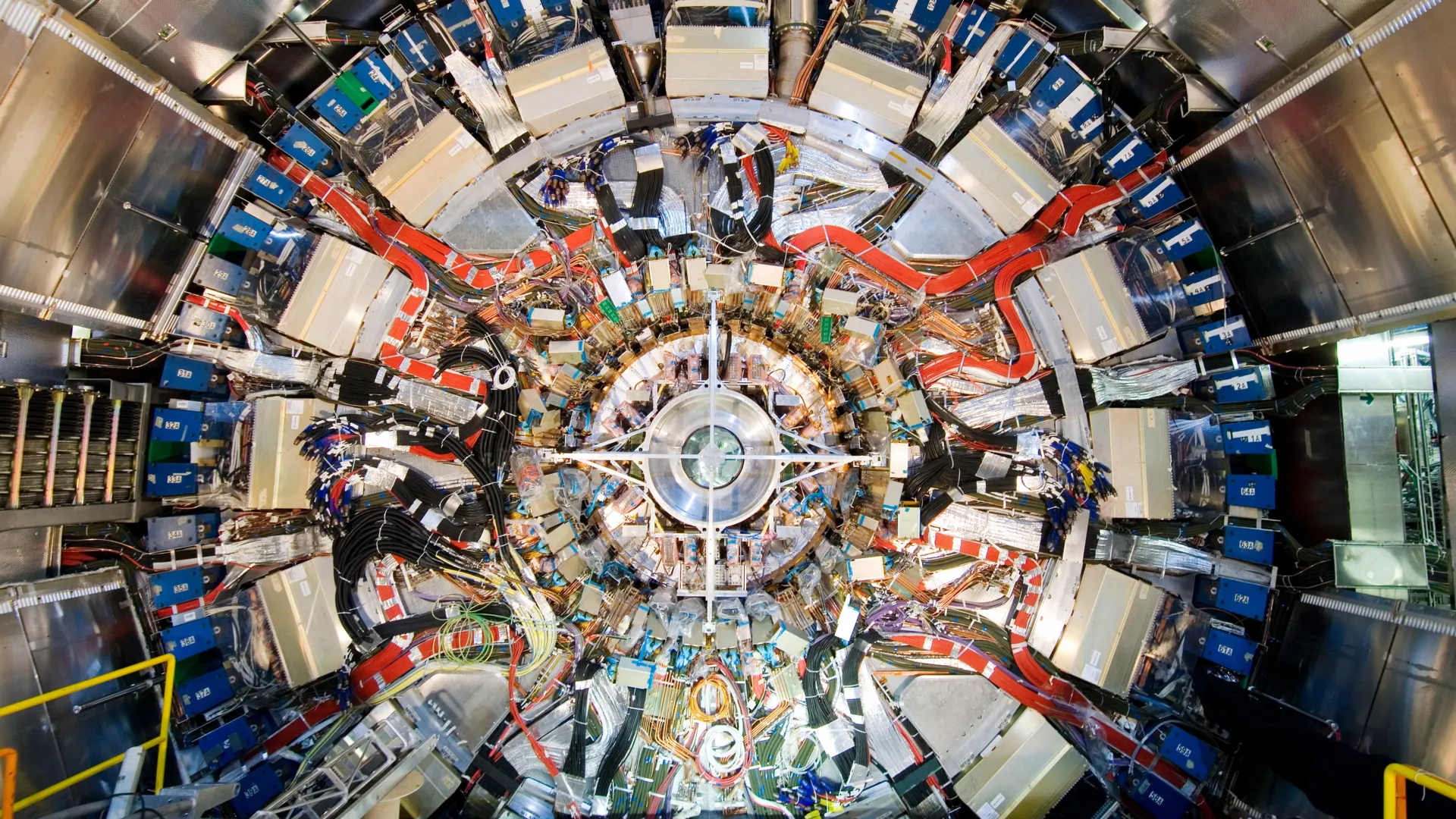
In quantum computing, for example, entanglement allows multiple qubits to be manipulated together rather than one at a time, making it possible to carry out multiple calculations simultaneously. Testing Quantum Entanglement at Extreme Energies What remained less clear was whether entanglement could survive under far more extreme conditions, including the violent, high-energy particle collisions produced at CERN. To investigate that question, an international team used the ATLAS experiment at CERN's Large Hadron Collider (LHC) near Geneva, Switzerland.
Instead of studying photons or other relatively long-lived quantum systems, the researchers searched for entanglement between pairs of Z bosons, massive particles that exist for only a tiny fraction of a second before decaying. The Z bosons examined in the experiment came from the decay of a Higgs boson, the particle discovered at the LHC in 2012. A Higgs boson can briefly decay into two Z bosons, which then decay into pairs of electrons or muons.
The Higgs bosons themselves are produced when protons traveling at 99.99% the speed of light collide at energies reaching thirteen trillion electron volts. Fleeting Z Bosons Leave Quantum Clues Behind Although Z bosons disappear almost immediately after they are created, the ATLAS detector can accurately measure the electrons and muons produced by their decay. Researchers analyzed the angles at which those particles emerged and used that information to reconstruct the spins of the original Z bosons.
That allowed the team to determine whether the two Z bosons displayed the correlations expected from quantum entanglement. The measurements provided strong evidence that they did. The result represents one of the highest energy confirmations of quantum entanglement ever achieved.
Extract — continue reading at the source.