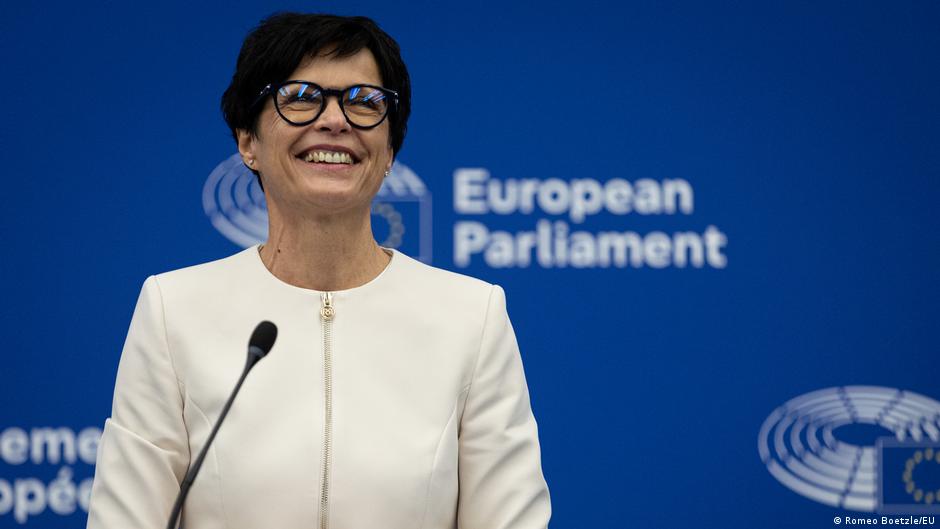
The European Commission wants to inject new momentum into its enlargement process, which has seen some candidate countries waiting for decades to join. Albania, Montenegro, Moldova and Ukraine are currently the frontrunners to join the bloc, with EU officials expressing the hope that Montenegro could do so as early as 2028. "A larger union is a long-term investment in Europe's peace, security and prosperity," Enlargement Commissioner Marta Kos told journalists in Strasbourg on October 6.
One key question is how the EU can take in more countries in the near future without becoming harder to run or running the risk of democratic backsliding in new member states. The Commission's answer to this question is to simultaneously require candidate countries to meet EU standards and get the bloc itself to reform by removing obstacles in the accession process and protecting its democratic values. One of the main stumbling blocks in accession negotiations so far has been the need for unanimous decisions across all 27 members.
In the past, individual states have often blocked a candidate's progress because of bilateral issues. The delays caused by Hungary's blocking of Ukraine's negotiation process are a prominent example. Now — and not for the first time — the Commission is recommending that member states move away from the principle of unanimity for decisions like the opening of negotiation clusters, replacing it with qualified majority voting.
"Every cluster that you open is subject to three individual decisions, and every single decision is subject to unanimity. It's mind-blowing, and I think this clearly needs to go," a Commission official, who wished to remain anonymous, told journalists on Tuesday. The catch is that a shift to qualified majority voting would itself require a unanimous decision.
"I have some reservations as to whether there will be unanimous agreement from the member states to move to qualified majority voting," Tinatin Akhvlediani, head of the enlargement program at the Centre for European Policy Studies (CEPS) told DW, pointing to previous attempts to change voting rules that were shot down by member states. To incentivize reform in candidate countries, the Commission is proposing gradual integration, which means that these countries could be granted some of the benefits of membership before joining — as long as they meet the EU's criteria. "Gradual integration is not a substitute for full membership.
It is the accelerator for enlargement," Kos said on Tuesday, underlining that the process would stay merit-based. This could have a motivational effect on candidate countries, Nina Vujanovic, a research fellow at Brussels-based think tank Bruegel, told DW: "Reforms are important, but it is also important to reward that process a little bit earlier, ahead of accession," she said. Earlier access to EU benefits is not entirely new: Montenegro, for example, already participates in the Single Euro Payments Area (SEPA) even though it is not yet a member.
Extract — continue reading at the source.