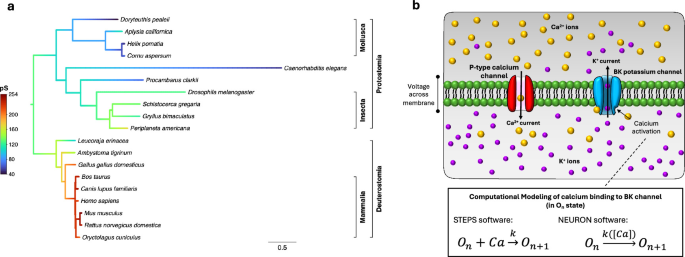
The large-conductance calcium-activated potassium (BK) channel plays a critical role in neuronal excitability and spike timing precision. Mammalian BK channels are distinguished by an exceptionally high unitary conductance (~250 pS), while invertebrates exhibit a significantly lower unitary conductance. We confirmed the evolutionary trend to high unitary conductance and used computational models to examine how differences in unitary conductance affect calcium activation of BK channels and influence neuronal dynamics.
We show that mammalian BK channels are activated more efficiently by calcium and generate stronger repolarizing currents than lower unitary conductance channels. Channels with lower unitary conductance require greater channel density in the cell membrane, leading to stronger competition for calcium and reduced activation. In contrast, high unitary conductance channels minimize competition, enabling more effective activation and repolarization.
Incorporating these channel properties into a neuronal model revealed that mammalian-type BK channels enhance spike-timing precision, consistent with the evolution of fine motor control and advanced neuronal processing in mammals. Neurons generate electrical signals via the activity of ion channels embedded in their membranes, which conduct currents selectively and may be activated by voltage changes across the membrane or by binding ligand molecules. The “Big Potassium” channel (BK channel, encoded by the slo-1 gene1) has a special property in that it is activated both by a depolarizing voltage and intracellular calcium.
Expressed extensively throughout the central nervous system, it plays an essential role in cell excitability and neurotransmitter release2,3, regulates neural firing3,4, and both excessive or insufficient activity of this channel is implicated in many neurological disorders such as epilepsy, ataxia, and intellectual disability4,5. BK channels consist of four identical subunits, which form a pore that conducts potassium current selectively across the cell membrane at a characteristic single-channel, or unitary, conductance when the channel is activated. This unitary conductance describes the current that one single ion channel will conduct across the membrane at typical physiological conditions.
The BK channel is characterized by a strikingly large unitary conductance compared to other types of ion channels6. BK channels require high, micromolar levels of calcium to activate, which is achieved by close localization to calcium-permeable channels such as the P-type calcium channel (CaP)7,8. The nanodomains that form around these clusters in which the calcium concentration is sufficiently high to activate the channel are small in size, of the order of 10 nm9.
The CaP channel is activated by voltage and conducts a calcium current mainly from outside the cell to inside, which is a depolarizing current. The BK potassium channel is activated both by voltage and the calcium influx from the CaP channel, and conducts a potassium current from inside the cell to outside, repolarizing the cell (Fig. 1b). The importance of BK channels in neuronal functioning is apparent by their persistence throughout millions of years of evolution (Fig. 1a and Table 1).
Extract — continue reading at the source.