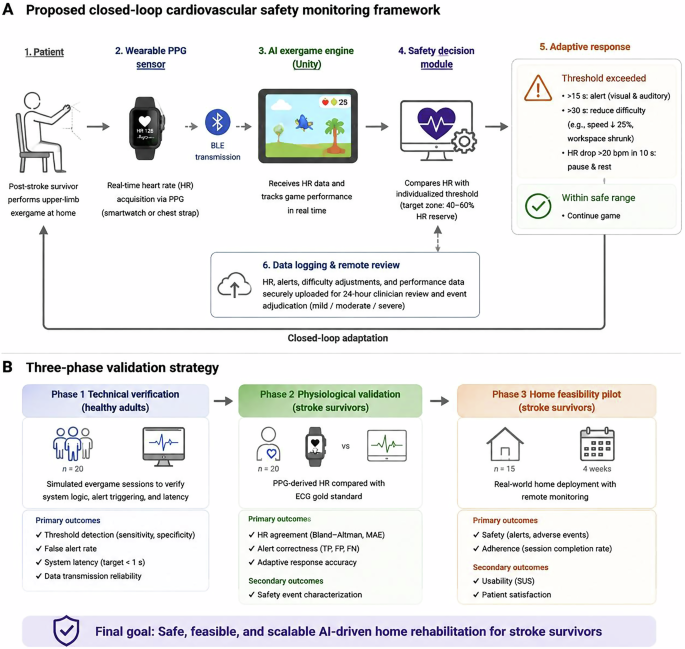
We extend Tannús and colleagues’ AI-driven rehabilitation exergame by proposing a closed-loop adaptive framework integrating real-time heart rate monitoring for cardiovascular safety. A three-phase validation roadmap is outlined. This commentary provides a technically specified pathway to transform passive motor assessment into responsive, safe home rehabilitation for stroke survivors.
We read with great interest the study by Tannús and colleagues, “AI-driven low-cost rehabilitation exergame as a lightweight framework for stroke assessment,” recently published in npj Digital Medicine1. The authors demonstrated that upper-limb motor performance, captured through a standard RGB camera, can predict Fugl-Meyer Assessment (FMA) scores with high accuracy using an interpretable linear model. Their choice to prioritise transparency and low-cost scalability represents a meaningful contribution to digital stroke rehabilitation.
Here, we focus on a single, clinically urgent extension of the Tannús framework: integrating real-time cardiovascular safety monitoring into the exergame’s adaptive loop. While their system accurately assesses motor function, unsupervised home use raises the risk of overexertion in stroke survivors with often-compromised cardiac status. We propose a closed-loop adaptive framework where heart rate feedback modulates game difficulty or triggers alerts, ensuring exercise intensity remains within individually safe limits.
This commentary’s sole novel contribution is a technically specified, clinically validated pathway to achieve such closed-loop safety, moving beyond general speculation. The Tannús framework focuses on kinematic assessment of motor performance. However, rehabilitation effectiveness and physiological safety represent complementary dimensions of therapeutic dosing.
Stroke survivors frequently present with cardiovascular comorbidities, autonomic dysfunction, or medication-modified heart rate responses. The American Heart Association/American Stroke Association scientific statement on physical activity for stroke survivors emphasises that exercise prescriptions should be individualised based on cardiovascular status and medication effects2. Age-predicted heart rate zones are commonly used in practice, yet β-blocker therapy and post-stroke autonomic impairment can blunt chronotropic responses.
Furthermore, observational studies have demonstrated that upper-limb task practice in chronic stroke often elicits low cardiovascular load, with only a subset of tasks reaching moderate-intensity thresholds3. These findings suggest that exercise intensity is highly task-dependent and may not be adequately inferred from movement amplitude alone. In this context, integration of real-time heart rate monitoring into camera-based exergames could enhance safety oversight and allow adaptive dosing.
Extract — continue reading at the source.


